Security & Compliance
Q-Day is coming: Here’s how to prepare for the threat of a quantum computer

Sharon Goldberg
Cloudflare
Governments worldwide are demanding that data stay within their borders. The industry’s typical solution, which localizes traffic to physical data centers in each region, leads to higher costs, slower performance, reduced resilience, and limited fallback when things go wrong. We think there’s a better way. This session shares Cloudflare One’s vision for using cryptography instead of geography to keep data in region. We walk through our approach to regionalizing key management, traffic inspection, logging, and operations, and where we’re headed with post-quantum cryptography by 2028.
0:02Okay, good afternoon. Thank you for coming. I know it's been a busy couple of days in all the ways. So thank you so much for being here to hear this presentation. So my name is Sharon Goldberg. I'm a senior product director here at Cloudflare. I have two portfolios. One of them is the post -quantum migration for Cloudflare. And then I have another portfolio, which is the data sovereignty implementation for Cloudflare. Flare 1, which is our SASE platform. So I'm going to be talking specifically about the SASE platform here. I might have made a deathly mistake, which is I forgot to include a slide on what our SASE platform is. So excuse me for that. It's been a busy couple of weeks. How many people know what our SASE platform is? How many people are customers of our SASE platform? Okay, great.
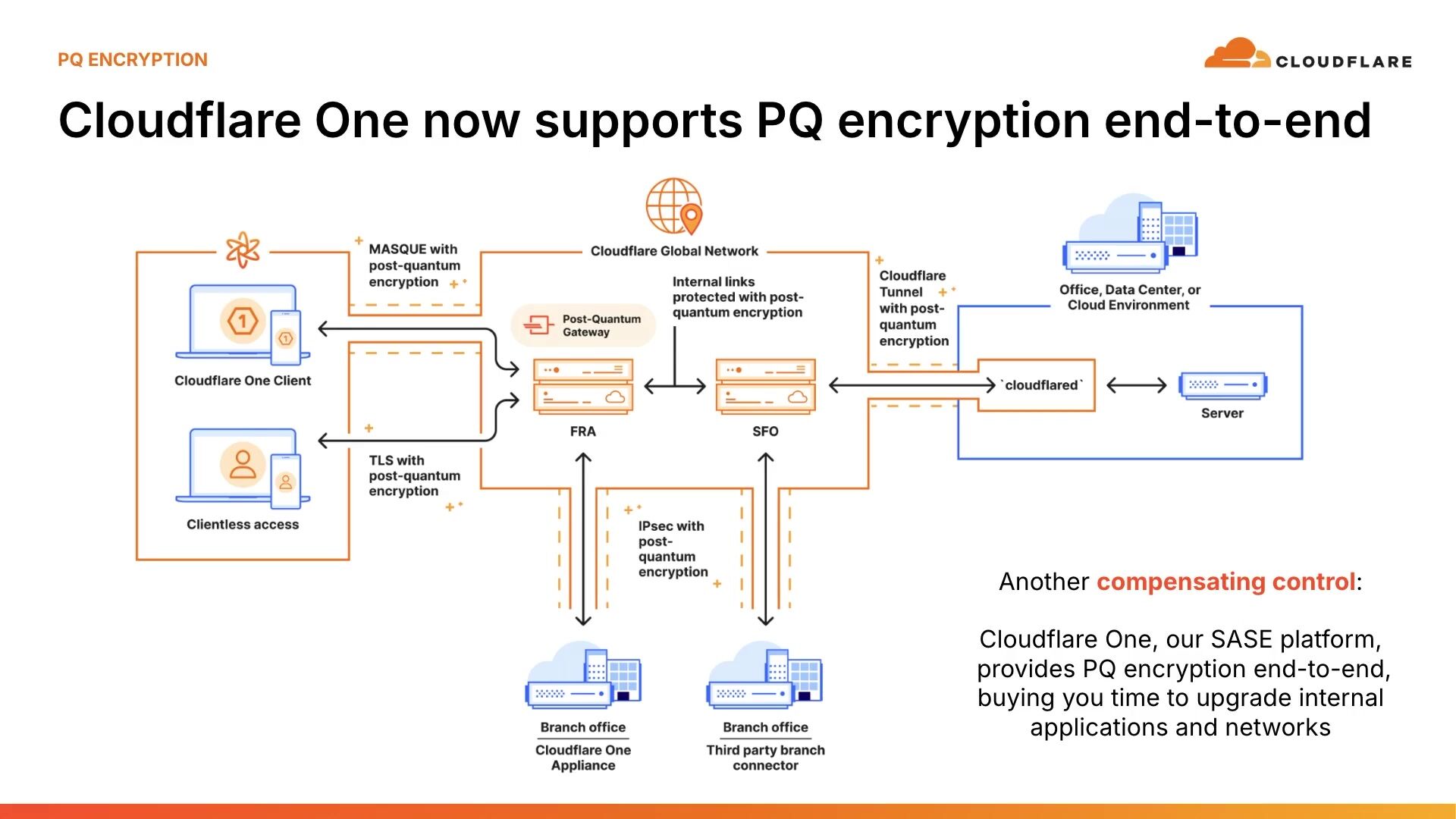
0:51So we have a SASE platform. I really should have a slide. I don't, so I'm just going to have to talk it through because it's silly to start without that. And so our SASE platform has many different ways for people to put their enterprise networking on Cloudflare. One way you can do it is to put a client on your laptop, like a VPN client, and that would connect you into our network. You can use it clientlessly through a browser. You can use it through an IPsec on-ramp. You can connect your data centers through our server agent, which is Cloudflare Tunnel, which you may or may not use for your server. CDN use cases, it's the same Cloudflare tunnel. And so all of these on-ramps and off-ramps can connect you in and allow you to build an enterprise And we also offer a secure web gateway, which we call Cloudflare Gateway, which does TLS break and inspect.
1:39And we also offer data loss prevention and many other services on top of that. And we also have a product called Cloudflare Access, which allows you to do remote access to private websites. put websites behind single sign -on mfa device context all of those things and then control your people's access into your enterprise site so it's a full enterprise networking suite that has all of those components and so we have a global network and for a long time our sassy platform was built on the global network but we've had very strong feedback from our customers that they want to see a sovereign architecture for our SASE platform. And so this talk is about what we're building. I haven't put anything in here that I don't know that's being built right now, but you can't use all the things I'm going to show, okay?
2:33So that's kind of where we are. Like there are engineers working on everything that I'm going to show now, but a lot of this is not yet available. So this is a sneak preview. And our leadership, Kyle Crum, wanted me to come here and talk about this before it was ready. So that's what I'm doing and I'm giving you an early preview, okay? So data sovereignty is increasingly a concern. This is just a fun slide with like a bunch of different frameworks that we found from all over the world in Canada and Turkey and Australia, Brazil, about regulation, about keeping data in country and protected in country. These have sort of different reaches and different mandatory requirements. But the sum total of this stuff is that we do get a lot of customers that say. our enterprise networking data should stay in country so if you're european you may want to ensure that when your people are logging into your enterprise network that their traffic is only going to be quote -unquote in europe right that the logs will only be stored quote -unquote in europe and so how do we achieve that right um so you can't give this presentation or this type of presentation without mentioning what happened in um in dubai when we had a data center that was struck by, basically in an act of war, the data center was struck and it went down.
3:52So we're kind of living in a world where these two competing trends, they really don't comport with each other. And one of them is saying we want everything to stay in country. And the other one is saying we want to have resilience, right? We want to have resilience against fiber cuts. We want to have, you know, we don't want to, this is an example I took from COVID times in South Korea, they built a vaccine registration platform, and it was housed in South Korea because they wanted privacy. But of course, they didn't have any resilience. And so when this vaccine appointments opened, the system crashed because it didn't know how to handle all the traffic, right? So these architectures in which everything is highly localized are generally less resilient if they don't have the ability to absorb traffic spikes and deal with attacks and absorb things like that.
4:37So if you know the history of Cloudflare, Cloudflare... born as a ddos company we're not about to do something like this right like we're not about to build something that would be a single server standing in one geography and that's all you connect to because that's just antithetical to just what this company is from its very first days right it's about resilience and it's about being able to absorb attacks that's that's where we started from and and i don't see how we get out of that world right and so while you may see our competitors saying like would you like to have um a sovereign version of our sassy platform in country x great we're going to open a data center in country x and you'll use the sassy platform inside that data center right that's a lot closer to what's happening here right where you just have a local system and it has to absorb all your traffic and then there's no slack right there's no you know additional bigger system that's going to protect you from disasters or traffic spikes and so that's really not how we think about the world and so we have a different approach.
5:36It's quite different from the rest of the industry and how we think about data sovereignty. And you saw Wesley Evans, hopefully, in his wine -colored suit on the main stage, talking about our vision for data sovereignty. So this is getting into the details of what Wesley was talking about, right? We have a global network, but we can still localize your traffic while still enjoying some of the benefits, not every single benefit, but some of the benefits of our global network and absorbing traffic that way. So that's what I'm... to talk about today. So we want to have data sovereignty while maintaining performance, resilience, and disaster recovery. And so I'll give you an example. If you're in a country and all of our data centers in that country go down and you are localized to that country and every single one of our data centers go down for some reason, then you would be offline, right? Because you've told us you wanted data sovereignty and you want to stay in that country.
6:25So you will be offline, but we would be able to, what we're building towards is you would be to switch the region to a different region so if you're comfortable at that moment saying you know i wanted to be regionalized to elbonia and now i'm happy to be regionalized to europe because every single data center in elbonia has gone down then you would make that switch you would have some packet loss at that moment but then you would be online again right and that's different than saying we're only in a data center in elbonia and you're stuck you can't move out of that data center so that's that's really the view that we're taking we give you a way to recover from disasters by regions in case of disasters and we're not going to overload um the traffic into one place um and so you know if you've if you know me you know i work on a lot of cryptographic systems at cloudflare this system like wesley said on the main stage is really built on cryptography right and so what we're going to do is we're going to keep your traffic encrypted and then we're going to bring it into the region decrypt it and process it there so it could still go on our network but it will be decrypted processed in the region and that's really the key to this architecture so I'll show you now the way it works.
7:33Okay actually before I show you so so we have we do have a FedRAMP high at Cloudflare that was a ton of work we built a little unicorn that was a FedRAMP high unicorn that was only for US and that worked great but it was a ton of work and then we wanted to bring it to more regions but unfortunately we can't build such a unicorn for every region we've had to build a much more generalizable architecture than what we built for FedRAMP. So when we built FedRAMP, we said, okay, we're gonna make sure that any data inspection is gonna happen in US data centers. So we brought it to US data centers and inspected it there. We wanted to make sure that the logs are only gonna be stored in the region. And so we have like a centralized, like our control plane is located in the US. And so the logs are stored in that control plane in the US.
8:19And similarly, we wanted to regionalize the control plane. So we make sure that this traffic only uses the American control plane. no other parts of the control plane that are outside the US. That's how we did FedRAMP. We happen to be having a control plane in the US, which worked to our advantage here. We don't have a control plane in Albania, right? So how do we bring this to Albania? So we're scaling this to more regions. And the way we're doing that is with cryptography. And so there's this sort of four-layer architecture where I'm kind of this talk is about the first three. And this one is . being done sort of at a platform level across the company. And this is actually done at the platform level, too. But Cloudflare One are the first customers of this. So we have a new GeoKey Manager.
9:05What it does is we're saying that if your company uses our enterprise networking platform, let me give the example of just Europe, just a very generic example. So you're using our enterprise networking platform. You want to keep your traffic in Europe. So what we would do is we would take your keys that are being used for your enterprise. networking platform use cases on Cloudflare One, and we would ensure that those are encrypted under a key that's only available in Europe. Let me just show you, actually, I can just show you now instead of talking it through, right? So this is your key, your AcmeCo, and you want to use Cloudflare One. You have all your keys. What we do is we decrypt, we encrypt these keys under the European region key, right? And that means they would be able to be, this key would be usable in Europe. So this data center is in San Francisco.
9:52This data center is in Frankfurt in Germany. Germany is in Europe. So the European region decryption key exists here. And so that key could be used to unwrap your key. And now we can do enterprise networking activities for you, like secure web gateway and things like that in Europe, because this key is available in Frankfurt. We can't do it in San Francisco because we don't have the key that's needed to decrypt your key. And so we can't actually... process your data outside of Europe because the key that's needed to process your data is only available in these European data centers right so in Frankfurt Frankfurt is part of NATO Frankfurt is in Germany Germany is part of NATO so we also have the decryption key for NATO we'll have the decryption key for Schengen we'll have the decryption key for Germany all of these servers have access to the keys for the region that they're living in right and in US we have the NATO key because US is part of NATO we have the US region key but we don't have Europe we don't have Schengen we don't have all the other keys. So those things will not be becoming available in your region.
10:45So the idea is when now we have the GeoKeyManager, we can make sure that we can only decrypt traffic in the specific region that you choose when you configure your account. And then what we do is when we do our break and inspect, when we terminate our tunnels, those are going to be done in your region. So I'll show you how that that's done. So that's for data in transit. With regards to logs, we have a number of solutions that we're building out now to make sure that you're logs are only decrypted in the region. So I'm going to show you that. And then the whole control plane itself, like I said, we do have a control plane in the US. We have control plane in Europe, but we don't have control plane everywhere. So we're starting to regionalize the control plane as well. And that's a whole other product that's being developed.
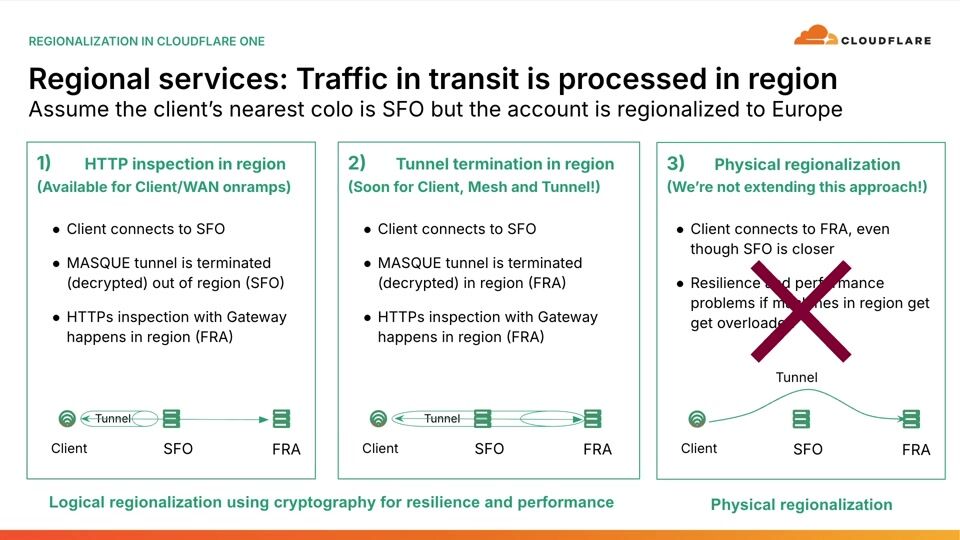
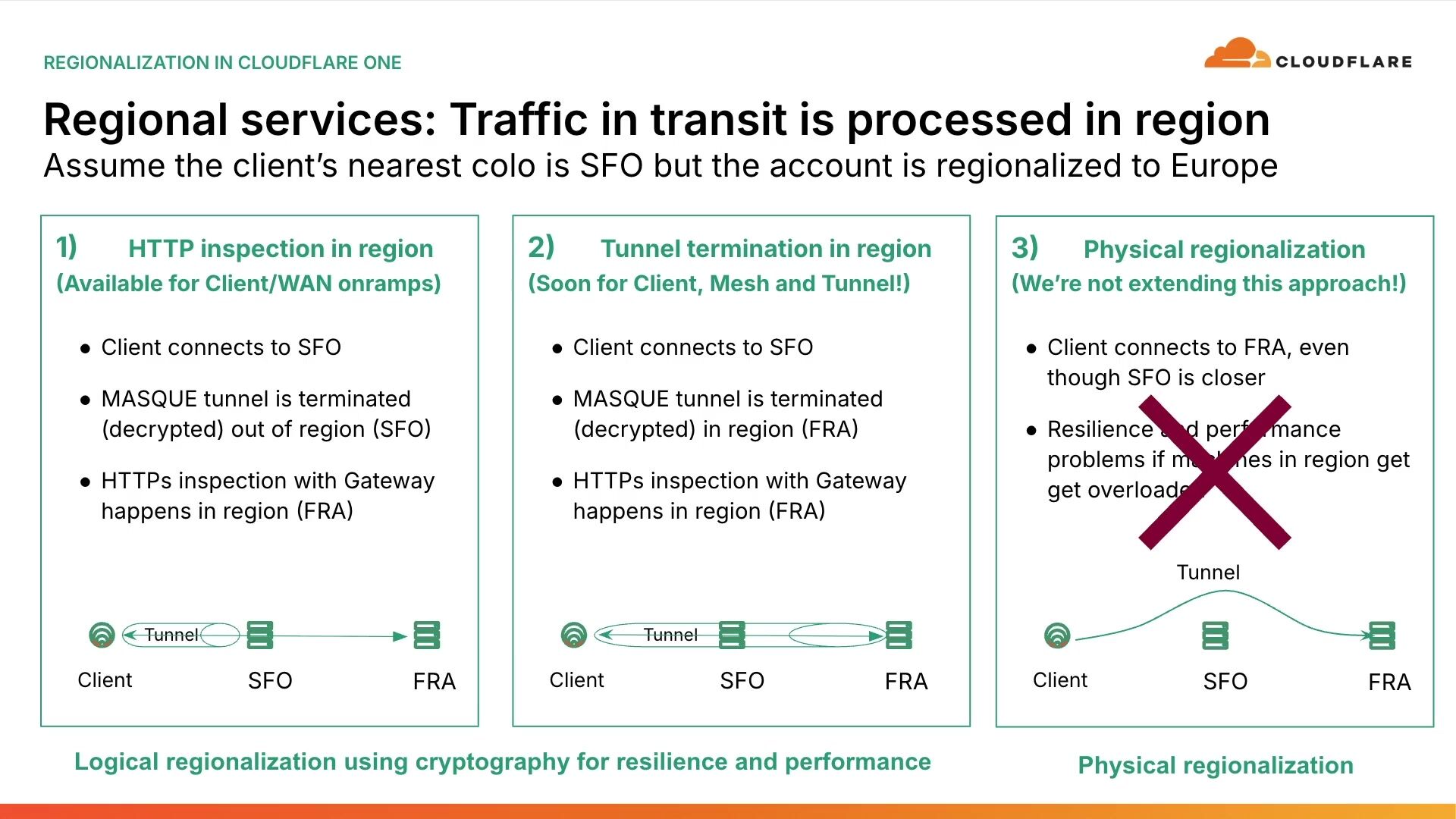
11:33And so that's going to be kind of a longer term thing for Cloudflare 1. I don't have an engineer building this right now for Cloudflare 1, but everything else that you see. see here is being built right now for Cloudflare 1. So this is going to be really exciting when it comes out. So we talked about the region key. So this is Acme Coast Key that's being used to do various activities in Cloudflare 1. And it's only available in the region to two servers in colos in the region for which this region key exists. So Frankfurt, Zurich, Geneva, all of those places, you would have this region key. And so traffic would be able to be brought into that region. and decrypt it okay this is a big slide now this next piece I'm going to talk about what we do with traffic in transit okay so we're going to focus on traffic in transit the way that cloudflare one our sassy platform works is that we have tunnels that you create from the client into cloudflare so if you are using a laptop with cloudflare one you have a cloudflare one client on your on your laptop it's that little orange cloud for of you who've used it what that thing does is it creates a tunnel from the client to Cloudflare's edge and what it'll do is it'll find the closest server that's closest to that client so in this picture we have a client that's probably here in San Francisco and they're on an account that's maybe regionalized to Europe but they're here you're here you're there's at least one European in this room so you're in this room you're in San Francisco and so your warp client your Cloudflare one client would be connected to the San Francisco
13:05Colo for Cloudflare. And so that tunnel would terminate here in San Francisco. But when we do the TLS break-in inspect with Cloudflare Gateway, what we're going to do is we're going to bring that traffic back to Europe, to Frankfurt, and we're going to do the break-in inspect there using the decryption key for the break-in expect, which would only be available in Europe because of the GeoKey So today, you can use what I just showed. You can do that now.
13:34when the on-ramp is Cloudflare One Can I get a glass of water if anyone's in the back? My voice is giving out. So if this is a Cloudflare One client, you can do this. If this is Cloudflare WAN, the same thing is true. What would happen is the Cloudflare WAN would connect to the nearest colo. And then when you're doing gateway break and inspect, we would bring the traffic all the way back to Europe. We would break and inspect it there. Is there going to be more latency if you're in San Francisco? But you just asked me to regionally. your traffic, so you're going to have to deal with it, right? If you don't want more latency, don't ask for regionalization. We'll do the break and inspect in San Francisco and all is well, right? So that's just the nature of how this works, okay? So this is what we have had for a while. We're integrating this with the region key manager, the new one. By the way, this is post -quantum. So cool. So we have a new version of this.
14:20It's a post -quantum geo key manager, in fact, because anytime we build crypto here now, it has to be PQ. Okay, so that's the piece. And so that works with client onramp, with mesh onramp, and with IPsec. Now what we're doing next is you'll say, hey, why is this tunnel terminating in San Francisco? Because I may actually have traffic that's not HTTP, that's not going through break and inspect, and I don't want it to be decrypted in San Francisco, right? So today you just, you can't do this, you don't have this, but what you're going to have is you're going to be able to say, actually, I want the tunnel to terminate in Frankfurt, right? We're going to bring it all the way back to Europe and everything that comes out of this tunnel will be coming out in Frankfurt, and then we'll be able to do whatever processing we're doing with it there. So it won't just be the TLS break and inspect that's going to be brought over.
15:07It's kind of anything that's going through here, any kind of traffic with any protocol, whether we break and inspect or not. We're going to terminate it there. And so this is going to be supported for Cloudflare when client on-ramps, for mesh on-ramps, and also for Cloudflare Tunnel. Cloudflare Tunnel is our server agent, so that's how you connect a data center to our platform. So you can see that. be able to connect the data center and you'd be able to regionalize that and bring it all the way back to Europe. So if you're connecting a data center to Cloudflare you'd put the tunnel and then the tunnel would would would go through Cloudflare's network and go to Europe. One important thing I want to say and I'm really this is really cool I think in my opinion like we I never said that this traffic doesn't go through SFO or through Cloudflare and SFO right it still goes through San Francisco goes through our network but it's encrypted right so we're still gonna on-ramp you as fast as we can on to our network using Anycast so you can enjoy the benefits of our network and we don't get taken down by too much traffic concentration.
16:00But we're only going to decrypt your traffic that's regionalized. We're going to decrypt that in Frankfurt. So this is the way that we can balance all this traffic for customers that are concerned. They can choose to bring their traffic back to Europe. But we're not going to start having a European data center that you can only connect to and not connect to any other parts of Cloudflare. Because if we did that, we would force you to go over whatever internet you would find. and not get the benefits of our network and so you might have latency and problems and issues here we wouldn't be able to protect you with so that's the difference in our approach okay so that's what's coming none of this is available yet but it's coming and this we're not going to be doing we did actually do this this is what we did for FedRAMP but it really doesn't scale FedRAMP was okay because our network in US is so diverse but it's not going to be that diverse in every country in the world
16:51It will be diverse, but it just won't be as large, let's say. It's a massive network in the US. OK, so next question. So that was data at transit. Now we're going to talk about data at rest or logs. So when we do things with Cloudflare 1, we Jenniferate a lot of logs. So as an example, we would create gateway logs, which show for all of your employees which websites they visited, if there was some sort of sensitive information that they We would have DLP logs, right? So we have all these logs that we do, like every SASE platform, to give you visibility into what your employees are doing with the network. And so where are those logs going to be stored? So the answer to that is different, depending on what region you're in. We have a product called CMB. And what that means is, with CMB today, what it means is you can select to have your logs stored in our core data centers in the US or in our core data centers in Europe.
17:45You can choose. us soon you'll be able to do this with India too so we're adding more as time goes on and so Wesley and his and you know the crew of data data people data platform people that that I work with now are building out additional regions so that we don't just have US and EU and we can start to have more places now the thing is we had this extremely cool idea about the week before I came here and It was like one of those serendipitous moments where it made it to the Q4 roadmap in like a week, which was like the coolest thing ever, I have to say. I'm not supposed to say that, but it was just so cool. So we had this idea, and the idea is the following. If we're bringing traffic all the way back to somewhere, and I put Sydney here specifically, because we don't now have a version of CMB in Sydney yet, that I don't have an engineer working on Sydney yet.
18:38Maybe we will soon, but let's say Sydney. We, if we bring the traffic back, back to Sydney, right? This traffic is here. And now it's being processed and logs are being generated. All that stuff's happening in Sydney. So what if we just push the logs out of this server in Sydney and send it directly to the customer using our log push product? So we would stream the logs directly out of this box. Because it's already in Sydney, we're going to stream it out to you directly from where the logs are being created. And they're being created in Sydney because we brought the traffic to Sydney to process it, right? So that's basically regional edge log push. We've had an edge log push. for project product for a while now we're going to make it regionalized so if we're already bringing traffic to your region then we just push it out from your region instead of sending it back to core data centers you will have regionalized logs the the sad thing about this is analytics will not work because we're not going to retain the logs anymore but if you're in a region where you really need not to have the logs stored outside of your country you would be able to get them to your logging systems and process them yourself in country yourself So you wouldn't get our analytics, but you would at least get your logs and you would know that they were staying in your region.
19:43So I'm really excited about this because it's very enabling. We don't have to wait for this feature. We can just regionalize things and then stream them out, done. And now you have any region that we can support regional services, we can also support regional logs. So that's coming soon. Some of my colleagues probably haven't even seen this yet because we figured this out last week. So that's coming. There is also efforts to regionalize the control. plane. What regions are coming online? These are regions that are available, that are going to be available with this. There are other regions that will also be available that you can ask your account team about. I listed a few of them here. It will have to go region by region because we need to make sure when we turn on a region, I just want to share this, when we turn on a region, we need to make sure we have enough connectivity that if one of the ISPs in the region just goes down or something that we're not offline as an example right if you're building a global network and you have some servers in albania and there's one isp in albania and it goes down that's fine the citizens of albania will then connect to something they'll go to frankfurt they'll connect to frankfurt and they'll be online so we're not that worried about losing a data center in certain countries so while we may have really good connect like lots of data centers in that country we may not have the resilience to say you know we can regionalize them to this region and fail closed if the region fails so we have to be careful when we open a region right we can have lots of data centers in lots of
21:15places in the world but we may not have the resilience for that to be the one place where we're able to inspect your traffic right so that's where we're being a conservative so if you are in a region that's not on this slide you know talk to your account team and we'll see what we can do okay so that's that's the way to think about it and then what i didn't put on this is really like um if there is if there is a situation like there is some sort of performance issue what we're building towards is that you would choose your region and if you see that that region is not performant for you you could choose a different region that would be bigger and that might improve your performance so you would accept the fact that like i'm no longer regionalized to germany only but maybe i'm regionalized to europe right because germany is not going to be resilient enough for me at this specific time because of something happening right so so that's the idea of the architecture to make it really flexible for people.
22:02So just to summarize, I'm out of time, where we are and where we're going. So GeoKeyManager actually has been developed. It's just being integrated with Cloudflare One right now. Traffic flows anywhere but only decrypted in region. So we can bring the traffic with gateway to your region and decrypt it only in the region now. What's coming next is bringing the full tunnel right from the clients all the way to your... region that's what we're developing right now it will come at the beginning of next year we have log storage in region like where we retain logs we have that for us and eu right now we will retain them in the us or the eu per your choice we're going to bring india there there will be more coming online but then the next solution which is the regional log delivery where we're streaming the logs directly to you that's actually going to come for any region that has regional services you'll be able to stream logs out of that region right because It depends not on us storing logs.
22:57It's just about streaming them out from where we bring the traffic. So that's coming very soon as well. There is a private beta for CDN use cases for the regionalized control plane. And so, unfortunately, I don't have the sign-up sheet. But in about half an hour, there's going to be a presentation with Wesley Evans, Alyssa Starzak. They're going to be talking about this exact issue for the CDN. So that will be coming first. And then Cloudflare 1 will need to onboard onto that. That's the next piece, okay? So I don't know if you understand how big of a project this has been for us. This is really engineering the plumbing of CF1, and I hope it shows kind of the commitment we have to data sovereignty and really offering what our customers need, because this was not a small job, and we have a lot of teams working on this right now.
23:42So thank you.
Sharon Goldberg
Cloudflare
Alissa Starzak, Emily Hancock
Cloudflare
Christopher Patton
Cloudflare
Be the first to know when registration opens and the agenda goes live.
---
title: "Cloudflare One’s vision for data sovereignty: Cryptography over geography"
url: "https://www.cloudflare.com/connect/2026/session/cloudflare-ones-vision-for-data-sovereignty-cryptography-over-geography"
year: 2026
---

# Cloudflare One’s vision for data sovereignty: Cryptography over geography

[Watch session](https://www.cloudflare.com/connect/2026/session/cloudflare-ones-vision-for-data-sovereignty-cryptography-over-geography)

## Session details

- **Track:** Security & Compliance
- **Topics:** Data compliance & localization, Emerging tech & post-quantum
- **Solution areas:** SASE & Workspace Security (Cloudflare One)

## About this session

Governments worldwide are demanding that data stay within their borders. The industry’s typical solution, which localizes traffic to physical data centers in each region, leads to higher costs, slower performance, reduced resilience, and limited fallback when things go wrong. We think there’s a better way. This session shares Cloudflare One’s vision for using cryptography instead of geography to keep data in region. We walk through our approach to regionalizing key management, traffic inspection, logging, and operations, and where we’re headed with post-quantum cryptography by 2028.

## Speakers

- [Sharon Goldberg](https://www.cloudflare.com/connect/speakers/2411674) — Senior Product Director, Cloudflare

## Transcript

[0:02] Okay, good afternoon. Thank you for coming. I know it's been a busy couple of days in all the ways. So thank you so much for being here to hear this presentation. So my name is Sharon Goldberg. I'm a senior product director here at Cloudflare. I have two portfolios. One of them is the post -quantum migration for Cloudflare. And then I have another portfolio, which is the data sovereignty implementation for Cloudflare. Flare 1, which is our SASE platform. So I'm going to be talking specifically about the SASE platform here. I might have made a deathly mistake, which is I forgot to include a slide on what our SASE platform is. So excuse me for that. It's been a busy couple of weeks. How many people know what our SASE platform is? How many people are customers of our SASE platform? Okay, great.

[0:51] So we have a SASE platform. I really should have a slide. I don't, so I'm just going to have to talk it through because it's silly to start without that. And so our SASE platform has many different ways for people to put their enterprise networking on Cloudflare. One way you can do it is to put a client on your laptop, like a VPN client, and that would connect you into our network. You can use it clientlessly through a browser. You can use it through an IPsec on-ramp. You can connect your data centers through our server agent, which is Cloudflare Tunnel, which you may or may not use for your server. CDN use cases, it's the same Cloudflare tunnel. And so all of these on-ramps and off-ramps can connect you in and allow you to build an enterprise And we also offer a secure web gateway, which we call Cloudflare Gateway, which does TLS break and inspect.

[1:39] And we also offer data loss prevention and many other services on top of that. And we also have a product called Cloudflare Access, which allows you to do remote access to private websites. put websites behind single sign -on mfa device context all of those things and then control your people's access into your enterprise site so it's a full enterprise networking suite that has all of those components and so we have a global network and for a long time our sassy platform was built on the global network but we've had very strong feedback from our customers that they want to see a sovereign architecture for our SASE platform. And so this talk is about what we're building. I haven't put anything in here that I don't know that's being built right now, but you can't use all the things I'm going to show, okay?

[2:33] So that's kind of where we are. Like there are engineers working on everything that I'm going to show now, but a lot of this is not yet available. So this is a sneak preview. And our leadership, Kyle Crum, wanted me to come here and talk about this before it was ready. So that's what I'm doing and I'm giving you an early preview, okay? So data sovereignty is increasingly a concern. This is just a fun slide with like a bunch of different frameworks that we found from all over the world in Canada and Turkey and Australia, Brazil, about regulation, about keeping data in country and protected in country. These have sort of different reaches and different mandatory requirements. But the sum total of this stuff is that we do get a lot of customers that say. our enterprise networking data should stay in country so if you're european you may want to ensure that when your people are logging into your enterprise network that their traffic is only going to be quote -unquote in europe right that the logs will only be stored quote -unquote in europe and so how do we achieve that right um so you can't give this presentation or this type of presentation without mentioning what happened in um in dubai when we had a data center that was struck by, basically in an act of war, the data center was struck and it went down.

[3:52] So we're kind of living in a world where these two competing trends, they really don't comport with each other. And one of them is saying we want everything to stay in country. And the other one is saying we want to have resilience, right? We want to have resilience against fiber cuts. We want to have, you know, we don't want to, this is an example I took from COVID times in South Korea, they built a vaccine registration platform, and it was housed in South Korea because they wanted privacy. But of course, they didn't have any resilience. And so when this vaccine appointments opened, the system crashed because it didn't know how to handle all the traffic, right? So these architectures in which everything is highly localized are generally less resilient if they don't have the ability to absorb traffic spikes and deal with attacks and absorb things like that.

[4:37] So if you know the history of Cloudflare, Cloudflare... born as a ddos company we're not about to do something like this right like we're not about to build something that would be a single server standing in one geography and that's all you connect to because that's just antithetical to just what this company is from its very first days right it's about resilience and it's about being able to absorb attacks that's that's where we started from and and i don't see how we get out of that world right and so while you may see our competitors saying like would you like to have um a sovereign version of our sassy platform in country x great we're going to open a data center in country x and you'll use the sassy platform inside that data center right that's a lot closer to what's happening here right where you just have a local system and it has to absorb all your traffic and then there's no slack right there's no you know additional bigger system that's going to protect you from disasters or traffic spikes and so that's really not how we think about the world and so we have a different approach.

[5:36] It's quite different from the rest of the industry and how we think about data sovereignty. And you saw Wesley Evans, hopefully, in his wine -colored suit on the main stage, talking about our vision for data sovereignty. So this is getting into the details of what Wesley was talking about, right? We have a global network, but we can still localize your traffic while still enjoying some of the benefits, not every single benefit, but some of the benefits of our global network and absorbing traffic that way. So that's what I'm... to talk about today. So we want to have data sovereignty while maintaining performance, resilience, and disaster recovery. And so I'll give you an example. If you're in a country and all of our data centers in that country go down and you are localized to that country and every single one of our data centers go down for some reason, then you would be offline, right? Because you've told us you wanted data sovereignty and you want to stay in that country.

[6:25] So you will be offline, but we would be able to, what we're building towards is you would be to switch the region to a different region so if you're comfortable at that moment saying you know i wanted to be regionalized to elbonia and now i'm happy to be regionalized to europe because every single data center in elbonia has gone down then you would make that switch you would have some packet loss at that moment but then you would be online again right and that's different than saying we're only in a data center in elbonia and you're stuck you can't move out of that data center so that's that's really the view that we're taking we give you a way to recover from disasters by regions in case of disasters and we're not going to overload um the traffic into one place um and so you know if you've if you know me you know i work on a lot of cryptographic systems at cloudflare this system like wesley said on the main stage is really built on cryptography right and so what we're going to do is we're going to keep your traffic encrypted and then we're going to bring it into the region decrypt it and process it there so it could still go on our network but it will be decrypted processed in the region and that's really the key to this architecture so I'll show you now the way it works.

[7:33] Okay actually before I show you so so we have we do have a FedRAMP high at Cloudflare that was a ton of work we built a little unicorn that was a FedRAMP high unicorn that was only for US and that worked great but it was a ton of work and then we wanted to bring it to more regions but unfortunately we can't build such a unicorn for every region we've had to build a much more generalizable architecture than what we built for FedRAMP. So when we built FedRAMP, we said, okay, we're gonna make sure that any data inspection is gonna happen in US data centers. So we brought it to US data centers and inspected it there. We wanted to make sure that the logs are only gonna be stored in the region. And so we have like a centralized, like our control plane is located in the US. And so the logs are stored in that control plane in the US.

[8:19] And similarly, we wanted to regionalize the control plane. So we make sure that this traffic only uses the American control plane. no other parts of the control plane that are outside the US. That's how we did FedRAMP. We happen to be having a control plane in the US, which worked to our advantage here. We don't have a control plane in Albania, right? So how do we bring this to Albania? So we're scaling this to more regions. And the way we're doing that is with cryptography. And so there's this sort of four-layer architecture where I'm kind of this talk is about the first three. And this one is . being done sort of at a platform level across the company. And this is actually done at the platform level, too. But Cloudflare One are the first customers of this. So we have a new GeoKey Manager.

[9:05] What it does is we're saying that if your company uses our enterprise networking platform, let me give the example of just Europe, just a very generic example. So you're using our enterprise networking platform. You want to keep your traffic in Europe. So what we would do is we would take your keys that are being used for your enterprise. networking platform use cases on Cloudflare One, and we would ensure that those are encrypted under a key that's only available in Europe. Let me just show you, actually, I can just show you now instead of talking it through, right? So this is your key, your AcmeCo, and you want to use Cloudflare One. You have all your keys. What we do is we decrypt, we encrypt these keys under the European region key, right? And that means they would be able to be, this key would be usable in Europe. So this data center is in San Francisco.

[9:52] This data center is in Frankfurt in Germany. Germany is in Europe. So the European region decryption key exists here. And so that key could be used to unwrap your key. And now we can do enterprise networking activities for you, like secure web gateway and things like that in Europe, because this key is available in Frankfurt. We can't do it in San Francisco because we don't have the key that's needed to decrypt your key. And so we can't actually... process your data outside of Europe because the key that's needed to process your data is only available in these European data centers right so in Frankfurt Frankfurt is part of NATO Frankfurt is in Germany Germany is part of NATO so we also have the decryption key for NATO we'll have the decryption key for Schengen we'll have the decryption key for Germany all of these servers have access to the keys for the region that they're living in right and in US we have the NATO key because US is part of NATO we have the US region key but we don't have Europe we don't have Schengen we don't have all the other keys. So those things will not be becoming available in your region.

[10:45] So the idea is when now we have the GeoKeyManager, we can make sure that we can only decrypt traffic in the specific region that you choose when you configure your account. And then what we do is when we do our break and inspect, when we terminate our tunnels, those are going to be done in your region. So I'll show you how that that's done. So that's for data in transit. With regards to logs, we have a number of solutions that we're building out now to make sure that you're logs are only decrypted in the region. So I'm going to show you that. And then the whole control plane itself, like I said, we do have a control plane in the US. We have control plane in Europe, but we don't have control plane everywhere. So we're starting to regionalize the control plane as well. And that's a whole other product that's being developed.

[11:33] And so that's going to be kind of a longer term thing for Cloudflare 1. I don't have an engineer building this right now for Cloudflare 1, but everything else that you see. see here is being built right now for Cloudflare 1. So this is going to be really exciting when it comes out. So we talked about the region key. So this is Acme Coast Key that's being used to do various activities in Cloudflare 1. And it's only available in the region to two servers in colos in the region for which this region key exists. So Frankfurt, Zurich, Geneva, all of those places, you would have this region key. And so traffic would be able to be brought into that region. and decrypt it okay this is a big slide now this next piece I'm going to talk about what we do with traffic in transit okay so we're going to focus on traffic in transit the way that cloudflare one our sassy platform works is that we have tunnels that you create from the client into cloudflare so if you are using a laptop with cloudflare one you have a cloudflare one client on your on your laptop it's that little orange cloud for of you who've used it what that thing does is it creates a tunnel from the client to Cloudflare's edge and what it'll do is it'll find the closest server that's closest to that client so in this picture we have a client that's probably here in San Francisco and they're on an account that's maybe regionalized to Europe but they're here you're here you're there's at least one European in this room so you're in this room you're in San Francisco and so your warp client your Cloudflare one client would be connected to the San Francisco

[13:05] Colo for Cloudflare. And so that tunnel would terminate here in San Francisco. But when we do the TLS break-in inspect with Cloudflare Gateway, what we're going to do is we're going to bring that traffic back to Europe, to Frankfurt, and we're going to do the break-in inspect there using the decryption key for the break-in expect, which would only be available in Europe because of the GeoKey So today, you can use what I just showed. You can do that now.

[13:34] when the on-ramp is Cloudflare One Can I get a glass of water if anyone's in the back? My voice is giving out. So if this is a Cloudflare One client, you can do this. If this is Cloudflare WAN, the same thing is true. What would happen is the Cloudflare WAN would connect to the nearest colo. And then when you're doing gateway break and inspect, we would bring the traffic all the way back to Europe. We would break and inspect it there. Is there going to be more latency if you're in San Francisco? But you just asked me to regionally. your traffic, so you're going to have to deal with it, right? If you don't want more latency, don't ask for regionalization. We'll do the break and inspect in San Francisco and all is well, right? So that's just the nature of how this works, okay? So this is what we have had for a while. We're integrating this with the region key manager, the new one. By the way, this is post -quantum. So cool. So we have a new version of this.

[14:20] It's a post -quantum geo key manager, in fact, because anytime we build crypto here now, it has to be PQ. Okay, so that's the piece. And so that works with client onramp, with mesh onramp, and with IPsec. Now what we're doing next is you'll say, hey, why is this tunnel terminating in San Francisco? Because I may actually have traffic that's not HTTP, that's not going through break and inspect, and I don't want it to be decrypted in San Francisco, right? So today you just, you can't do this, you don't have this, but what you're going to have is you're going to be able to say, actually, I want the tunnel to terminate in Frankfurt, right? We're going to bring it all the way back to Europe and everything that comes out of this tunnel will be coming out in Frankfurt, and then we'll be able to do whatever processing we're doing with it there. So it won't just be the TLS break and inspect that's going to be brought over.

[15:07] It's kind of anything that's going through here, any kind of traffic with any protocol, whether we break and inspect or not. We're going to terminate it there. And so this is going to be supported for Cloudflare when client on-ramps, for mesh on-ramps, and also for Cloudflare Tunnel. Cloudflare Tunnel is our server agent, so that's how you connect a data center to our platform. So you can see that. be able to connect the data center and you'd be able to regionalize that and bring it all the way back to Europe. So if you're connecting a data center to Cloudflare you'd put the tunnel and then the tunnel would would would go through Cloudflare's network and go to Europe. One important thing I want to say and I'm really this is really cool I think in my opinion like we I never said that this traffic doesn't go through SFO or through Cloudflare and SFO right it still goes through San Francisco goes through our network but it's encrypted right so we're still gonna on-ramp you as fast as we can on to our network using Anycast so you can enjoy the benefits of our network and we don't get taken down by too much traffic concentration.

[16:00] But we're only going to decrypt your traffic that's regionalized. We're going to decrypt that in Frankfurt. So this is the way that we can balance all this traffic for customers that are concerned. They can choose to bring their traffic back to Europe. But we're not going to start having a European data center that you can only connect to and not connect to any other parts of Cloudflare. Because if we did that, we would force you to go over whatever internet you would find. and not get the benefits of our network and so you might have latency and problems and issues here we wouldn't be able to protect you with so that's the difference in our approach okay so that's what's coming none of this is available yet but it's coming and this we're not going to be doing we did actually do this this is what we did for FedRAMP but it really doesn't scale FedRAMP was okay because our network in US is so diverse but it's not going to be that diverse in every country in the world

[16:51] It will be diverse, but it just won't be as large, let's say. It's a massive network in the US. OK, so next question. So that was data at transit. Now we're going to talk about data at rest or logs. So when we do things with Cloudflare 1, we Jenniferate a lot of logs. So as an example, we would create gateway logs, which show for all of your employees which websites they visited, if there was some sort of sensitive information that they We would have DLP logs, right? So we have all these logs that we do, like every SASE platform, to give you visibility into what your employees are doing with the network. And so where are those logs going to be stored? So the answer to that is different, depending on what region you're in. We have a product called CMB. And what that means is, with CMB today, what it means is you can select to have your logs stored in our core data centers in the US or in our core data centers in Europe.

[17:45] You can choose. us soon you'll be able to do this with India too so we're adding more as time goes on and so Wesley and his and you know the crew of data data people data platform people that that I work with now are building out additional regions so that we don't just have US and EU and we can start to have more places now the thing is we had this extremely cool idea about the week before I came here and It was like one of those serendipitous moments where it made it to the Q4 roadmap in like a week, which was like the coolest thing ever, I have to say. I'm not supposed to say that, but it was just so cool. So we had this idea, and the idea is the following. If we're bringing traffic all the way back to somewhere, and I put Sydney here specifically, because we don't now have a version of CMB in Sydney yet, that I don't have an engineer working on Sydney yet.

[18:38] Maybe we will soon, but let's say Sydney. We, if we bring the traffic back, back to Sydney, right? This traffic is here. And now it's being processed and logs are being generated. All that stuff's happening in Sydney. So what if we just push the logs out of this server in Sydney and send it directly to the customer using our log push product? So we would stream the logs directly out of this box. Because it's already in Sydney, we're going to stream it out to you directly from where the logs are being created. And they're being created in Sydney because we brought the traffic to Sydney to process it, right? So that's basically regional edge log push. We've had an edge log push. for project product for a while now we're going to make it regionalized so if we're already bringing traffic to your region then we just push it out from your region instead of sending it back to core data centers you will have regionalized logs the the sad thing about this is analytics will not work because we're not going to retain the logs anymore but if you're in a region where you really need not to have the logs stored outside of your country you would be able to get them to your logging systems and process them yourself in country yourself So you wouldn't get our analytics, but you would at least get your logs and you would know that they were staying in your region.

[19:43] So I'm really excited about this because it's very enabling. We don't have to wait for this feature. We can just regionalize things and then stream them out, done. And now you have any region that we can support regional services, we can also support regional logs. So that's coming soon. Some of my colleagues probably haven't even seen this yet because we figured this out last week. So that's coming. There is also efforts to regionalize the control. plane. What regions are coming online? These are regions that are available, that are going to be available with this. There are other regions that will also be available that you can ask your account team about. I listed a few of them here. It will have to go region by region because we need to make sure when we turn on a region, I just want to share this, when we turn on a region, we need to make sure we have enough connectivity that if one of the ISPs in the region just goes down or something that we're not offline as an example right if you're building a global network and you have some servers in albania and there's one isp in albania and it goes down that's fine the citizens of albania will then connect to something they'll go to frankfurt they'll connect to frankfurt and they'll be online so we're not that worried about losing a data center in certain countries so while we may have really good connect like lots of data centers in that country we may not have the resilience to say you know we can regionalize them to this region and fail closed if the region fails so we have to be careful when we open a region right we can have lots of data centers in lots of

[21:15] places in the world but we may not have the resilience for that to be the one place where we're able to inspect your traffic right so that's where we're being a conservative so if you are in a region that's not on this slide you know talk to your account team and we'll see what we can do okay so that's that's the way to think about it and then what i didn't put on this is really like um if there is if there is a situation like there is some sort of performance issue what we're building towards is that you would choose your region and if you see that that region is not performant for you you could choose a different region that would be bigger and that might improve your performance so you would accept the fact that like i'm no longer regionalized to germany only but maybe i'm regionalized to europe right because germany is not going to be resilient enough for me at this specific time because of something happening right so so that's the idea of the architecture to make it really flexible for people.

[22:02] So just to summarize, I'm out of time, where we are and where we're going. So GeoKeyManager actually has been developed. It's just being integrated with Cloudflare One right now. Traffic flows anywhere but only decrypted in region. So we can bring the traffic with gateway to your region and decrypt it only in the region now. What's coming next is bringing the full tunnel right from the clients all the way to your... region that's what we're developing right now it will come at the beginning of next year we have log storage in region like where we retain logs we have that for us and eu right now we will retain them in the us or the eu per your choice we're going to bring india there there will be more coming online but then the next solution which is the regional log delivery where we're streaming the logs directly to you that's actually going to come for any region that has regional services you'll be able to stream logs out of that region right because It depends not on us storing logs.

[22:57] It's just about streaming them out from where we bring the traffic. So that's coming very soon as well. There is a private beta for CDN use cases for the regionalized control plane. And so, unfortunately, I don't have the sign-up sheet. But in about half an hour, there's going to be a presentation with Wesley Evans, Alyssa Starzak. They're going to be talking about this exact issue for the CDN. So that will be coming first. And then Cloudflare 1 will need to onboard onto that. That's the next piece, okay? So I don't know if you understand how big of a project this has been for us. This is really engineering the plumbing of CF1, and I hope it shows kind of the commitment we have to data sovereignty and really offering what our customers need, because this was not a small job, and we have a lot of teams working on this right now.

[23:42] So thank you.

## Related sessions

- [Q-Day is coming: Here’s how to prepare for the threat of a quantum computer](https://www.cloudflare.com/connect/2026/session/q-day-is-coming-heres-how-to-prepare-for-the-threat-of-a-quantum-computer)
- [Can we have both data sovereignty and a global Internet?](https://www.cloudflare.com/connect/2026/session/can-we-have-both-data-sovereignty-and-a-global-internet)
- [Merkle Tree Certificates and the next phase of the WebPKI](https://www.cloudflare.com/connect/2026/session/merkle-tree-certificates-and-the-next-phase-of-the-webpki)

## More from Connect

- [All sessions](https://www.cloudflare.com/connect/)
- [Get notified for Connect 2027](https://www.cloudflare.com/connect#2027)


