
Agent Cloud
No Priors: A live conversation with Dane Knecht, CTO of Cloudflare


Sarah Guo, Dane Knecht
Conviction Partners LLC · Cloudflare

In this episode of Screaming in the Cloud, host Corey Quinn will be joined by Dane Knecht, CTO of Cloudflare. They will engage in a wide-ranging discussion on the evolution of cloud computing, tracing how infrastructure is shifting from traditional cloud workloads toward an agentic cloud designed for autonomous AI agents. Along the way, Dane pulls back the curtain on Cloudflare’s own internal AI deployment. It’ll be a conversation about scale, resilience, and what happens to infrastructure philosophy when the Internet stops being mostly human.
0:00People want like very clear, sometimes rigid rules about like tell me I'm allowed to deploy X but not Y. And it's like well, if it was that simple then an agent could do it. The thing that I'm asking you to do is exercise human judgment and come back to me and tell me like okay, if we released this thing on a Friday afternoon, could I explain to a customer what happened if it caused an incident? >> [music]
0:30>> Ladies and gentlemen, please welcome to the Frequency Podcast stage Dane Connect and Rita Kozlov, joined by your host Corey Quinn. >> No, thank you both for agreeing to do this. I'm pleasantly surprised that it required less arm twisting than I would have thought. Uh a question I love to ask people at conferences every chance I get. It's perfectly calibrated for just how much of a jerk I want to be to someone based upon the scale of their company. You ask someone where they work and they give you an answer. And what no matter what that answer is, I like to respond with oh great, what do you folks do? So small scrappy startup, they're thrilled to tell you. Large giant bank, they get offended by this. And like the final form is some of the modern tech companies cuz they don't know either. So we're going to see where you all fall on that. Cloudflare, what do you folks do?
1:16>> We we help protect the internet at at at our core. Build a better internet and you know, we move packets faster than anyone else around the world and uh sprinkle some compute on that and uh some inference and uh uh let people build amazing things. >> Would you agree or are we going to start a fist fight here? >> That's my boss, so. >> Oh, I you kind of have to at that point. No, I get it. I get it. >> This episode is sponsored in part by my day job, Duck Bill. Do you have a horrifying AWS bill? That can mean a lot of things. Predicting what it's going to be, determining what it should be, negotiating your next long-term contract with AWS, or just figuring out why it increasingly resembles a phone number but nobody seems to quite know why is. To learn more, visit duckbillhq.com.
2:04Remember, you can't duck the duck bill bill, which my CEO reliably informs me is absolutely not our slogan. >> I had Matthew Prince on this show twice in previous years, and at the time it really did feel like Cloudflare was a CDN, but no one wants to talk about a CDN because that's only interesting to networking nerds, guilty. And then there was the other stuff you did sort of sprinkled on top. And and I'm not sure when that happened, but these days talking about you as a cloud provider, specifically I would argue the premier cloud provider that is legible to agents, stopped being something I guess aspirational and started being an accurate description of the reality. It it felt like it was a long time coming, but almost without noticing you got there.
2:51>> I think the fist would have come out even 10 years ago if you called this a CDN. That that was a term that we never really embraced. >> 10 years ago was actually when the developer platform started. And it really started as an internal platform for how how we could accelerate our own development. We like to ship a lot of things, as I'm sure most people know. And you know, in order to make it cost effective, you had to have a way of letting engineers iterate quickly and reduce reduce that that cost. You know, it started out just the one one compute serverless primitive. And actually at the time Matthew kind of told us he said you know, he said it takes 10 years for a platform. You know, maybe you get lucky and you do it in eight, but you know, no one really becomes a platform in less than 10 years.
3:36And maybe this changed with AI, but you know, it it took us the full 10 years I think to really kind of reach that level. >> It's strange in that the legacy cloud providers for lack of a better term, and I'm not I'm increasingly starting to think of them that way, everyone is saying that they are building for agents. That's the way of the future. That's the current state of the world. And you give an agent, a cloud code or whatever it is you're using, access to credentials in that environment and tell it to go and build a thing and it gives the polite corporate robotic version of what the hell is this and trips all over itself. Computers, they're just like us. Increasingly I have found that that is not the case in my weird ridiculous experiments on top of Cloudflare specifically. What if you found changes when the agent is now the primary consumer/implementer of your platform instead of a human being?
4:30>> I mean the legacy providers, they're still built on all the same primitives, right? And so then they just kind of change the label, the the stock agent in front of it. >> But there's still like an instance and then there's the block storage and the key the key defining characteristic is those teams are not allowed to talk to each other and it shows. >> At Cloudflare, you know, I I wish I could I wish I could say we 10 years ago predicted that agents would come and so we built all of it for for for this moment. But we did start out with fundamentally, first of all, a very different architecture, which it's really hard for the clouds to back into and that that's kind of Matthew and Michelle are students of Clay Christensen and that's kind of the whole innovator's dilemma, right? Is once you have this machine that's really working, that's been worked out around a single primitive, it's really really hard to roll out something that's going to disrupt it and be 100 times more efficient.
5:21The foundation that we were starting from when agents were becoming a thing 3 years ago and like as they've evolved was just very different and that's allowed us to I mean one thing that we do very much have in our DNA is innovation, having retaining an ability to have agility and flexibility when things come up. And so I I think it was a combination of we have the right foundation, but also once, you know, new protocols like MCP came out or we started paying attention to harnesses, like we're able to adapt very quickly to whatever is happening in that moment. >> I mean if you think about it, the whole cloud transition that everybody was been told to do for the last 20 years, it really was just shifting from a data center to another data center.
6:08You know, data center you owned to a data center owned by one of a couple people. >> Yeah, that's the lift portion of the lift and shift. The shift Yeah, we'll get to that later as soon as we finish migrating off the mainframe. >> I think S3 was a was a new kind of primitive uh but then it kind of regressed from there. Then it went back to just like oh yeah, we'll just give you a full machine and basically everything that you had uh in a data center before. Never kind of going back to uh you know core principles of like what are you trying to accomplish? You're trying to accomplish efficiency. You know, how can you make sure that every machine that you have is running you know as close to capacity at any given point? >> It it's weird in that things are speeding up incredibly, but also at the same time it feels like there's a there's a drag effect on it too. I remember a few weeks ago during your birthday celebration uh which is an interesting thing for a company to say.
6:54You released the CF command line tool which solved between Wrangler and your other one. I forget what it was. We were constantly at odds with each other. Hey, a unified experience. And I remember giving that to my agent the first day it came out like hey, use this instead. Cloudflare just released it and like watching its thinking traces were I don't know. Sounds like horse to me, but I'll give it a shot. And it also was trying to deploy things on top of Cloudflare Pages, which is largely been deprecated and not the way that you folks envision these things going on. But getting the new way of doing things into the into the weights and getting the old way the old ways of doing them out when there's 10 years of historical blog posts on it being baked in feels like it's an incredibly difficult challenge. >> There There were some arguments there. I I was like no, it needs to be called Wrangler cuz that's what the LOMs know.
7:41Uh it needs to be Wrangler 3. And And they're like no, no like you know we should have called it CF all along. That's better. And we're going to do it in a way that you know the agents will still just prefer it. It'll just be such a better experience for the agents. And I I think you know they've been proven right. Like you know first of all CF's a lot easier to type, but the agents seem to naturally be able to understand it. And it was kind of built actually more for an agent to use than a human to use. >> Oh the search >> operator, I've explained in plain English the thing you're trying to do and it spits it out. Awesome. I love it. I'm still trying to figure out how I can exploit that, you know, write Python code for me because why not? Everything's a database if you hold it wrong. The other side of it though, I have to say Wrangler was a bad name in that you go six months without touching it and what is this Wrangler thing installed on my system? CF at least you can trace down and sort of start to understand a bit more effectively.
8:29Legible to humans and legible to agents does seem to be converging. >> We hired an engineer who had just moved to Austin and they were like, yeehaw, Wrangler. Um and you know, you you find these things endearing and then like seven, eight, nine years later you're like, still called Wrangler. >> It's weird though the casual decisions we make like, yeah, I'll go back and fix that later and you realize inadvertently it's like, yeah, I'm just going to replace the entire foundation in that building and oh no, suddenly well I guess that's what we're calling it forever more. >> But it's interesting there's there's both sides to it. On one hand, there's everything that LLMs know and obviously it's hard to displace that. On the other hand, it's so much easier in some ways to get LLMs to adopt something new if you can be a bit intentional about it because you can just give it a prompt and it will follow that prompt to the T, whereas humans are really very bad at following instructions and we do fall back to old habits much more easily.
9:24So I think that that was something that the team put a lot of thought and effort into that helped make the transition to CF so much easier. Like the fact that you can give it a single prompt and um before even migrating between versions of Wrangler that was something that I very [snorts] painstakingly come to a customer and be like, you guys really should do this and they'd be like, I don't want to fiddle around with this for a month. I want to do other stuff that's actually important to my roadmap and now it's like just give it this prompt and they're like, yep, I'm done and we did this with a bunch of teams internally. >> It's a near certainty that there was an internal debate around this so I want to make sure I call out something that I like. Um every provider now has skills you can give your agent that winds up explaining how to interface with the various things that we're using, how to how to contextualize this platform that you've suddenly gotten exposure to.
10:14And a without naming names, a lot of them are basically SEO for agents of oh anytime someone wants to deploy it, make sure you use this. So I went through yours and it is remarkably even-handed across the board. It is if you are doing this on Cloudflare, then go ahead and do this other thing. It didn't turn into and remember Cloudflare is the best, which some other skill packs do. That has been wildly annoying to me when you especially god forbid you have two of those things installed. So as fun as it is to wind up yelling at companies when they get things wrong, I do like to take a point every now and then of making it obvious when you've done something right. I'm sure someone was like oh think of the growth hacking we could achieve if we just basically sell our customers for glue.
11:01>> Well I mean I think that's pretty baked in our DNA. You know things like even just from privacy to transparency to the customers are not our data and and you know so that is not like a top-down thing that you know that is kind of baked into you know the people that we hire. There there was no like conscious decision. I'm glad to hear that. I'm actually excited to hear that you you say this but I actually didn't even know that. >> I was expecting that some providers would absolutely let marketing run loose inside of those skills. >> And some do. >> Less than I was worried about originally though, which is kind of awesome. Like one thing I'm realizing now is that we've been begging as humans for the internet to be better in various ways for 20 years. And only now that agents are a thing are companies actually getting off their corporate asses and doing something about it where oh yeah it turns out that we if we stuff like 8 MB of JavaScript into 2 KB instruction file, agents are just not going to click on the ads or read it anyway.
11:54So we should just put the text on a text file and make that available. It's like the second greatest thing to happen to the internet. Like it's it's reminiscent of GDPR day when a bunch of companies were suddenly unprepared, didn't know how enforcement was going to work. And for a few days they turned off the JavaScript and the entire internet was blazingly fast. like, you could have had this, but telemetry is important. >> So, you know what's funny about that is on GDPR day was the first time I was Initially the original Workers PM and it was the first time that we saw a jump in Workers adoption because so many European customers just deployed a worker that said if EU just don't serve that website because US companies just didn't even want to deal with it and didn't didn't know how to. >> Yeah, I have thoughts on that. None of them are acceptable for public distribution at this point because I can't quite tamp down the blistering stream of profanity that winds up playing out.
12:48So, a few weeks before this conference was a bunch of your releases during your birthday week. Folks have had time to play with them and now basically talk to a number of the folks here about those enhancements. I think only a small subset of them started with you know what your problem is and then developed into violence from there. So, the question that has come up though, do you consider Connect to be a developer conference? >> I mean, I absolutely consider it to be a developer conference. We don't consider it a place to go announce things. We consider a place to a convenient experience where you get to go meet peers, you get to go meet fellow Cloudflare employees, you get to learn something. At least that's our that's our hope. Like that's why you know no one stood up on stage and said, guess what, you know these three big announcements that we're doing, that that was very intentional. >> So, I want to shift a little bit because something that you've talked about a number of sessions that I caught the abstracts of and poked my head in to listen to, how have you folks changed how you're building and deploying things via the use of AI?
13:44Because I can talk about the insane nonsense that I build primarily in service of posting, but there's a difference between he he if this goes really well, thousands of people will see it or a stuff that you do is now a statistically significant portion of the internet as a blast radius. I don't think you get to YOLO slam it into into creation quite the way that I do. >> But a little over a year and a half ago we kind of wrote down what our like our our AI principles were handling. You know number one and number two was no vibe coding. At least on on the engineering side. And that's you know, and we also said, you know, if something gets deployed to production, there's no blaming AI either. So, uh, we still very much, you know, humans write code, uh, humans plan, humans do that, you know, they might use AI to assist them, but they own uh, what they're building, what they're shipping.
14:32Uh, and and we use AI as a tool to help accelerate that. Uh, but not to replace human judgment, uh, human thought, human creativity. >> That's sad. AI is really good at things that humans are bad at, right? So, um, you can a human can review code and miss stuff that AI is going to catch. And so, AI has been really instrumental to our code review process and I think has actually helped prevent incidents that otherwise would have happened. And similarly, yeah, I I think kind of coming from a culture of ownership, like no-vib coding doesn't mean, uh, yeah, don't use AI. I think that one of the challenges that we're all kind of seeing now too is um, there are things that vib coding is really great at, like putting together a prototype or we have a lot of non-engineering teams that really embrace vib coding because it helps them build personal software that otherwise, you know, we we'd have to go get a SaaS license for something that serves like maybe like 10% of their need.
15:36Um, so so in some ways it's been very empowering, but I think being very clear about what's been reviewed by person and what's going into production, having human judgment also for, you know, which code does need to be thoroughly reviewed, um, because it's going to be deployed to the edge and it's part of like a very very core service versus like maybe this is something completely new and experimental and that's, you know, only a package that we're giving to people to try out, like those are those things are very very different. >> Or or or things that are just uh, annoying. A human not going to find excitement over uh, rewriting next to uh, be faster and safer to run and also build and run on Cloudflare. >> There >> are a few humans, but I hear you. >> Yeah, I mean there's there's one human originally uh Slopfork Steve.
16:24You know, he gave it the plan, he gave it the guidelines. I've been asking for that for years and they're like this this project that this this is horrible. Uh and and finally like the AI was like yeah well the AI didn't have a choice. >> Yeah. >> Well the the interesting thing about that is he tried that experiment twice, once in October of last year and he kind of kicked the tires with it and also got bored with it because the AI wasn't good enough. And then fast forward to um you know the models that came out in like November, December and all of a sudden they're cooking with fire. >> It's odd. There's a weird judgment aspect of it. People using these things love it. People who have to consume the thing that gets put out on the other end is awful. Like my AI factory, your Slop cannon and it becomes a different challenge. Something we've learned pretty clearly over the past year has been that five coding is awesome and five maintaining is terrible and five maintaining someone else's AI Slop is that they're building an annex onto the last circle of hell just for that.
17:19It's terrible. So on some level you almost start to rebuild things five or six times where a rewrite used to be a complete anti-pattern variety of ways and now it's starting to feel like for some things it's the best practice. >> I mean we always thought of workers of the platform where people build Greenfield applications cuz it's just a very opinionated architecture that you get a lot of great things when you do it, but you're not going to go port you know an application that's been running you know for 10 years move it over to us and we were kind of fine with that cuz still there's a lot more Greenfield stuff being built. But all of a sudden we're seeing people that have these prompts that are literally rewrite my application to run on Cloudflare workers and and migrate it for me. And and all of a sudden like that that process even becomes cheap. >> For me the wild part that of everything you've released this year, it is the ability to have an agent spin something up on Cloudflare without even having an account and then okay now you can go ahead and claim it if you decide you want to keep it.
18:15Just the abuse concerns on something like that, the scale concerns you have to be dealing with too make that it it's a it's miracle from my perspective it even got shipped let alone stuck around. It it's one of the that the fastest mean time to dopamine moments on deploying something for the world to see that I've ever heard of. >> Well well so two parts of that. One is the abuse part we have an amazing trust and safety team which we've you know had 15 years >> have to. >> Yeah which we've had 15 years to hone that skill. So you know there's still obviously a lot of abuse but we are we're pretty good at handling it. And then you know honestly just the cost to deploy something like that on our platform is really just minimal. And and that's just because how we designed it. And so you know you know that that that the abuse part is probably the bigger issue that's the bigger concern but the cost not really.
19:07>> The interesting thing is we've over the past year really invested in our dashboard experience which as someone that still uses it has gotten so much better but now we're seeing so many people on X being like oh I use Cloudflare without ever having touched a dashboard. I just told my agent to go X Y and Z they created the account for me and everything and that that's the new era that we live in and I think that that's a requirement now. >> Finally got started getting good at it and then no one cares anymore. >> You have to have a dashboard because a demo on stage of it here's working with Claude code like what's product are we demoing here doesn't work. But the thing that works well for customers who are using it is not necessarily the thing that looks great on a stage. Those are two very different use cases from a UX perspective as it turns out.
19:53And you have to have it. It is a baseline requirement but your common case increasingly is customers never seeing. >> I think an interesting take on it maybe is that it it allows us to focus on our efforts on things where you do kind of have to have it maybe to explain a unique concept or to really visualize something. And like for example CRUD dashboards should have never been complicated in the first place right? If you have a decent enough design system in place and that part has been accelerated for our internal teams too through having a design system where um we actually increasingly even have PMs that ship parts of the dashboard because we already have the predefined criteria. >> Well, that's the whole cloud company problem.
20:38The predefined design system. Huh, you only have one. We've got eight and there's where the problem starts. It's you can you can tell when you're leaving one team's remit and heading into another. Consistency is horrible. >> Well, we like to pave our own way. We went 15 years without one. And so we only have one. >> What I found interesting is some of this even exposes itself through CF where there is still some inconsistency between namespaces, how things work with various services and I still maintain fix it now because this problem only gets exponentially worse with time. But it's a it is one of those areas that's very hard to wind up getting deployed it because that requires centralized coordination in a company that benefits by launching things without that centralized coordination. >> This episode is sponsored by my own company, Duck Bill.
21:25Having trouble with your AWS bill? Perhaps it's time to renegotiate a contract with them. Maybe you're just wondering how to predict what's going on in the wide world of AWS. Well, that's where Duck Bill comes in to help. Remember, you can't duck the Duck Bill bill, which I am reliably informed by my business partner is absolutely not our motto. To learn more, visit duckbillhq.com. >> It's definitely a spectrum, right? If you want innovation to go fast then making it all go through a bottleneck is really really hard and so you kind of have to make the tradeoff of letting teams sometimes define their own and a big part of our culture is ship but fix quickly and don't let issues sit around and linger because the more they collect us, the harder they become to fix.
22:17>> AI has kind of helped improve that somewhat. We built this thing called our engineering codex which is uh a set of RFCs on how we built. Uh and it turns out agents are really good at following, you know, we should have had those rules already written down for humans, but we didn't really. Uh but >> It's on the backlog. We'll get to it next sprint for sure, right? >> It turns out agents are even better at following instructions when you write them down. Uh but then you know that we pair that with another kind of Cloudflare principle that we like uh like guidelines and not rules. Uh so you know you know cuz rules rules were made to be broken so you're allowed to ask for exceptions. But you know you you have a good reason it needs to be thought out. But uh at least we're all starting from a common place of uh here's how you build on Cloudflare successfully. >> Internally, how do you handle the approach of autonomy with AI? Because on on the one hand, just go ahead and do whatever your little heart desires.
23:05Oh no, the payments database is not great. And despite all the beautiful lies we tell ourselves about Agile, when it comes to payments, we all do waterfall for a very good reason. Uh on the other, you want to go full-on cautious, great. Now I'm just hitting approve on everything. I'm getting decision fatigue and I feel like a Claude condom, which isn't a great place to be in. Like that that feels like my job of hitting the enter button could be replaced by the Dicky Bird at some point. How do you find the right place on that continuum? How do you think about it? >> Well, I mean there are one-way doors and uh not I mean if you're deploying something uh to the core runtime of uh workers, that needs to go through a lot of reviews and uh but if you're deploying a worker on that, which uh is going to have a much smaller blast radius, then you can kind of uh uh manage the surface area, then you might have a different set of criteria.
23:54>> The problem I found is that it's very easy to identify a one-way door usually after you've gone through it. It I found interesting novel failure cases of AI doing we'll call it curious things. Uh no one is as zealous about backups for example as someone who's just lost data. Like it feels like it's one of those everything's easy to predict after it happens. Uh what was the process of getting there like? >> So we have a uh a pretty regimented incident process uh where uh >> Your write-ups are gold, absolutely gold. >> And that that's that's the kind of the final outcome of it. But but you know it starts from when we declare it uh uh how we document it throughout it, uh the follow-ups, the prevents that come out of that. Uh and that's also what led to writing the codex of actually documenting, okay, well, we know what works here and doesn't work here and here's how to build if you want something to work. That's been uh you know very successful for us and but you know I think it's a concept I mean we're we're learning and documenting and and hopefully you know it's it's okay to make a mistake once, lose some mistakes and uh you know we we don't punish anyone for that.
24:50Uh if you make a mistake twice >> It's hard to fire an agent too which makes it even harder. >> But but that's why we have humans, right? Because some of that is very nuanced and I think people are pretty uncomfortable with that. People want like very clear sometimes rigid rules about you know like tell me I'm allowed to deploy X but not Y and it's like well if it was that simple then an agent could do it. The thing that I'm asking you to do is exercise human judgment and come back to me and tell me like okay if we released this thing on a Friday afternoon could I explain to a customer what happened if it caused an incident or do you feel so confident that um actually you know what ship it on a Friday, why not, right? >> Or it's a brand new product and no one's using it.
25:35>> Yeah. >> Ship it ship it on a Friday. >> Yeah, there's almost like a tearing ring of at some point oh wow this this runs the core network. We should probably have some diligence around this rather than yeah it's probably fine. You'd hope but then you see some of the tier one ISPs you start to wonder how accurate that really is. So I'm curious at this point of it it feels like every time I turn around and think well okay this is what Cloudflare does. I draw a circle around it in my mind and reasonable people can disagree but for a long time the primary value was back when it was hard to get a domain name with an SSL cert in front of a website. Great it was the thing that I went to. Yes your website talked a lot about security but people only care about that after they just failed to. Fun day to say that with the entire internet melting down from a fundamental security layer but which that's neither here nor there. Then it became this idea of uh of being increasingly interesting things usually at the edge it was where you were the strongest and now it seems that with things like object store, things like D one, things like durable objects, things that are that are turning into an absolute reimagining of what a cloud provider is, where it starts, where it stops.
26:44It feels like it's very hard to figure out what you do in some ways. I think probably for me, the straw that broke my back was the idea of using you as an AI gateway where all inference can route through you. Now it feels like, okay, I start to need like a flowchart to figure out what aspects of this you are and what you aren't. Am I the only customer you have that's starting struggling to keep abreast of what it is that you're putting out or am I again, I could easily be the dumbest person in this room. It would not be the first time. >> No, I definitely say one of our Achilles heels is customers tend to not know everything we do. And you know, we we tend to you know, have you know, a customer that comes from this, you know, one area and they know the workers very well or they know our bot management very well.
27:31And that's probably how we were telling the story. You know, but I think you know, over the past year and hopefully at the our our keynote here at the the trade show, you know, people really got to see how we can explain the platform in a way that is a little more coherent and that kind of explains what we do and everything it possible to do on it that you can kind of imagine. >> Part of the challenge too is that what is possible on the platform today and what is possible three months from now are going to not be completely congruent. And one of the hardest problems in this era that we're in is building any plan for a release or a talk in advance. I gave a talk earlier this spring about how AI speak Terraform like a tourist and that thing aged like fine milk. It's it's one of those areas of yeah, it's really good at that now, which is helpful because Terraform clearly hates its user.
28:22That's kind of its feature. But we all put up with it. Now we don't have to. The other piece of it though is that I still maintain that the areas that are not going to be industrialized are wisdom judgment. And I'm hoping that that holds true at some point, but even if it if it doesn't, I'm not quite sure where that leaves us. Like, at some point like, oh yeah, your job is to sit here in case the agent screws up because we need somebody to sue. That's not a great seat to be in. >> First of all, I'm glad you're talking about how hard it is for people that present and speak that you can't reuse talks anymore. That that thing becomes out of date. Like I used to be able to reuse things like 6 months apart, a year apart, but that's no longer the case. >> No, that they they melt. They are absolutely unusable. You can reuse a few of the jokes, a few of the general themes, but well, get out, get out, get out.
29:08I've started even when I give talks now, I feel obligated to call out the date when I say it because otherwise it's going to turn into a huh, look at this bad take you had. Yeah, what, 2004? Imagine that. >> There's kind of two things to what you were saying before too, right? One that's what Cloudflare has been doing has evolved and continues to evolve and sometimes um yeah, the the release cycles are our customer We've always prided ourselves in innovation, which means that we release a lot and our customers have always struggled to keep up. Um but I I I think that yeah, and then there's the second part of it which is how do you communicate it um which I think we're getting better and better at. But I I think an interesting thing too is you know, you said another word that we would generally shy away from which is edge, which is where I think people kind of get confused about what we do, right?
29:59Because they associate Cloudflare very closely with like, oh I would want to use you for things that are very close to my users. And as you were saying, we're increasingly doing things like triple object through object storage. And I think what that plays more to is we never thought of ourselves as an edge for that reason of we think of ourselves as a smart network where we can route things to the place where it makes the most sense for it to run. It doesn't necessarily always have to mean like everything everywhere all the time. It can also mean in one place and at one point in time and another place and another point in time if that's what makes sense. >> Yeah, the the question of course is >> how you make that legible to people, where huh, I have a bunch of users in one part of the world and over time they find the experience gets better as the smart network, for lack of a better term, winds up relocating things closer to them.
30:48It does lead challenges with things like data residency, which is becoming an increasing problem as various governments realize that they can legislate themselves a data center investment if they say the right things. It is a brave new world out there in a lot of respects and it's certainly not getting simpler. I think the idea of being able to hold the entire stack in one person's head has long since ceased to be an accurate representation of reality, but I think we've held on to that fantasy for a while. It's getting harder and harder to credibly cling to that belief. >> I mean, I wonder if you fast forward how many people will even have the stack in their heads and how much of the stack is in their agents. >> A a question that I'm having right now and as a platform provider with a bunch of partners with booths and what not, many of whom fall squarely into this, what is the defining characteristic to your view of where someone should build their own implementation of a thing versus going and paying for a product that does that thing?
31:46Um an easy example here is great. I'm not going to be able to go out and build a global network for uh for reasonable use, especially given the current price of components for things, and I don't have eight years to spend playing that game. Clearly I'll go with a provider that's out there. But if I want to have a a service on a website that does a thing that's basically a a digitized version where its biggest competitor is Microsoft Excel, well suddenly now I'm debating do I build it or do I buy it? How do you see that on >> So at least for Cloudflare, we we kind of think of what are kind of the primary systems of record and where's like kind of that data gravity? And we want to reduce that, but we want to put put it in places that have you know that actually are pretty trustworthy software like you know for HR systems, we want to use something that understands compliance.
32:31You don't want to vibe code compliance. >> All the Frontier Labs are outsourcing payroll for very good reason. >> Things like payments >> or finance tooling, you know, I don't see anyone coding an ERP anytime soon. That's just also because the risk, right? Like, you know, the CFO doesn't want to go to jail cuz someone you know decided to use a bad model. And so so, you know, for us those are the types of things that we said, okay, those are going to stick around cuz that's kind of a risk. But we'll give people a playground kind of above that. We'll make sure that data is accessible, easy for them to use, put kind of governance around it to make sure it's not leaking. And let them build their own interfaces on top of it. But keep the workflow and the you know kind of lower level engine inside of those places, you know.
33:17>> How do you think about it? >> I mean I agree with Dane. I you know I think conventional wisdom has always been does it make your beer taste better, right? So if it doesn't actually help your customers, then you probably should buy it rather than build it. I I think that that's no longer entirely true because we do spend so much time using tools that meet like 30% of the thing that we needed them for. And the cost for building, yeah, especially an interface on top of a system of record is so so low that there's no reason not to just kind of build your own. >> It feels like the open source world figured this out a generation ago. Software could be free as a puppy where the maintenance becomes a nightmare because you build a thing that service that perfectly services your needs and as soon as you get a second user, all hell is other people's requirements.
34:04Now it seems like that is less of a barrier than it once was, but there is still value in folks that think very deeply about a problem today. >> Yeah, I mean I think it's okay for things to just be single user now too, right? Like I I think that that's where the maintenance burden becomes expensive is once you get that second, third, hundredth user, but there's there's certain software that's like this is for me. I want a view of my team so that I can you know do a particular activity maybe at a team on site and I no one else is going to use it and it took me 5 minutes to build. I didn't need to go out and um sign off all of Cloudflare's um you know data for me to have access to a tool. >> All right. I mean we're seeing you know every every person sales building their own dashboards and their own tooling on top of Salesforce, right?
34:53Which would just be unthinkable in the past. But so that comes personal software. They don't have to worry about it scaling out to the rest of the company. They just have to worry about doing what they needed to do that day and you know I'm pretty bullish on personal software uh which you know I think fits very well into Cloudflare because you can deploy it for one person and or deploy it for 100 people and it kind of scales the same way. Um and you know and and every once in a while one of those pieces of personal software might end up being something that uh you know it is a sleeper hit and it does need to scale up. >> I also believe we're increasingly in the idea of killing your pets where all right I've built some personal software that I've been iterating on and it's gotten it's drifted a lot for its use case. Great. Throw it away and start over. Uh here are the interface points maybe planning for data migration backups again your friend but build a second one in parallel. See if that winds up solving the need better.
35:39It almost becomes a schedulable tradition. >> Mhm. I think that's where Cloudflare is not only uniquely suitable for scaling up but also for just state staying scaled zero, right? It costs you nothing if you're getting no requests and you're not doing anything with it. >> Well I guess the last big topic I want to get into with you folks before we call it an evening here is for a long time folks were talking about dead internet theory the sort of a conspiracy theory that the internet was largely bots talking to each other and now that is very clearly a credible way of thinking about this as the as an increased percentage of traffic I believe might have been a majority now uh becomes uh automated rather than human driven or human directed that changes the internet foundationally.
36:25How do you think about that? Because again robots do many things more efficiently than human. One thing they don't do is click on the ads which is going to be a problem for an awful lot of business models. >> Yeah I mean uh you know right now humans and uh agents are kind of surfing on the same uh internet and uh it's kind of in messy period where uh the the needs to work itself out but they probably should not be on the same internet. They, you know, they probably are more efficient ways of the each of them interfacing with it and as well as more efficient ways of monetizing. Um, you know, I I think uh you know, when people have ads on a page they're they're they know what their CPM is. They know about how much they're going to make uh you know, cost per million on an ad. There's no reason why an agent can't just, you know, with a micro transaction just pay that. Um and and that's kind of like what we've been building with our monetization gateway.
37:13Uh you know, put sites behind us, let people decide what their CPM is and uh you know, give give an agent a wallet and you know, let them go go wild uh using it. Uh but we are trying to give you know, the the site owners and creators those type of controls whether uh let them decide who gets in and who doesn't. >> Of course defaults matter because that's going to be what most people will wind up taking but it's it's weird. Some folks absolutely do not want agents interacting at all with their site. And one of the more inscrutable ones to my mind is Amazon's retail where they will actively block anything that looks to be bot driven. It's like the bot is coming to your website to buy a thing and give you money in return for goods. Well, we're going to build our own because we're Amazon.
37:59It's going to have a terrible UX. It's going to ship three years late after everyone else wants it and you were just going to be surprised when it finds lukewarm success in the market if I can that a second. But it feels like it's emblematic of a larger trend where folks are clinging to the way things used to be almost in a denial of the fact that the sea is changing. >> I think yes and no. We've also seen customers shift their perspectives and I think a lot of people are evolving on their thinking about yeah, a few years ago the world was, you know, bot versus human and now it can increasingly be bot on behalf of human. And so you you want to allow that traffic and we had a whole, you know, part of our conversation that was about AO and agents buying things because there's information available.
38:46So we're also seeing businesses that are actually leaning in and trying to inversely give agents as much access as possible to their content because they they they want agents to recommend them and things like that. >> I mean we early on we saw a lot of sites that just did not want their traffic to be used for training. The personal agents coming, Dots, Muse, Grokbot, you know, it's actually changing. We're actually having people that say, hey how do I make sure I let this in? Uh cuz they actually do want that traffic. Um and you know so you know what we we're trying to work with all those providers are to make sure they sign the requests, that they clearly state what their intentions are. And then the site owner can decide you know I want this in I don't want this in. You know for the most part you know their incentives are aligned that you know they want they want them in.
39:32>> Yeah it's a hard problem to solve for. I don't I don't think there's any clear right answer no matter what you do especially at your scale. People are going to be mad mad about it. That that is what the internet does. It's very good at not accepting the two very complex complex things can both be true at the same time and that doesn't fit in their tweet so we're just going to get angry about it. It's not ideal. I think that we're going to be seeing some interesting changes. So okay Connect 2027. Let's assume it's a year from now. What's changed? >> Oh boy I even if you said Connect I don't know January 15th 2027. >> It used to be what's going to be different in 25 years and like oh by then we're definitely going to have quantum computing powered by cold fusion and now 25 years later you can say the exact same things but here we are. Some things are very clearly changing too so I don't know that I would want to put a prediction out there which is why I'm making it your problem instead.
40:25Dane what do you think? >> A higher majority of people will have personal agents that are you know are running for them both at work and at home. You know I think today you know we hear a lot about the GPU crunch. I think you'll hear more and more about the CPU crunch because harnesses and things like that need CPU. Um you know hopefully cloud first the default place where you deploy all your durable agents and everyone has you know hundreds of them making their life easier and lets them go spend time on higher value things. >> If I had to guess I think a lot of the breakthrough might very well come from folks one layer of the stack who are building on top of you folks where it becomes like that is the thing that becomes the household brand the recognized name in non-technical circles. I'm not sure that you'd want it to be the other way of yes we're now going into consumer products feels like it's a bit of a pivot there but being able to be the the underlying infrastructure primitives that everyone else starts to build upon increasingly I am seeing at least on the a lot of the transport layer that Cloudflare has well gotten into that point.
41:30>> Yeah I mean we were just just before this I was in a session where John from OpenAI was showing how GPT sites is built on Cloudflare. We had Fabian on stage with me yesterday who was showing how Lovable built on Cloudflare so in that sense we've always viewed ourselves as the infrastructure layer and our goal is to give people that are very good at building these consumer experiences and that's why I think there's a lot that's been left to imagination still there's so much that's been unexplored. One thing that I'm actually very bullish on is real time and voice feels very early on and what we're seeing more and more folks experiment with that so I think you're right that we're trying to play it kind of the the layer slightly below.
42:20>> I mean at our heart we're an infrastructure company and so you know while there was a lot of you know a lot of questions really on like why why don't you build build a you know vibe coding website builder we're like well because we want to build the platform and we want to build the primitives that let there be 10 of them on us or hundreds of them on us and I and I think largely that's kind of played out. >> I feel like there are two kinds of infrastructure company in the world the kind that are have not been that we're an infrastructure company great that empowers an awful lot of things please build on top us and infrastructure companies that are mad about it and like to dilute themselves thinking nope no we're going to move up the stack now and compete with all of the people that build on top of us. I almost wonder at some level if that's an inevitable consequence of getting to a certain point of scale but it's refreshing to hear that you folks are not inflict affected by that yet.
43:09That's the one thing I hope doesn't change. >> We have a lot of conversations about it internally every once in a while and you know what what that layer on top keep keeps changing and one thing that we will do sometimes mostly just so that we have experience in house in understanding our customers perspective is we will build like an internal instance and [snorts] sometimes we'll open source it as an example right to even show people what putting together the pieces would look like because also just being infrastructure that doesn't show you you know it's like how to draw a horse and step one is very simple and then no I I swear you you could get to a horse so so that's one direction that we've found ourselves leaning in but it's not to say that I think as a company you can definitely build new muscles and there are muscles that I'm very proud that we've built over time but also understanding where your strengths are and where you're better off you know either letting people build on top of you or partnering [snorts] allows you to focus your energy on the things like building infrastructure is really hard and we have no shortage of problems to solve over there.
44:15>> You you would think that would be more broadly accepted than it is but now we're into the realm of people promising data centers in three months and they think it's basically at some tents and a generator um good luck have fun with that. It it takes work legitimate hard work to get these things built in a way that's sustainable and scalable and it's nice to see that folks are sweating those details. >> That's our job. >> I want to thank you both for taking the time to speak with me if people want to learn more probably not the people here in this room you you probably should know where to go to figure out more what Cloudflare is up to but for folks listening where's the best way to get started with Cloudflare these days? >> Go to cloudflare.com or point your agent at it and ask what what you know what what what can I what can I do >> Cloudflare? How can I use it? How can I make my apps better? >> How can I make it hysterical and poster is usually my prompt, but it works.
45:01>> Yeah. >> Someone had a great suggestion the other day. We published a blog post about what we used for our own internal AI review tool, and they were like, I just started pointing my agent at Cloudflare blog posts and being like, extract the parts that I could reuse from this and like start implementing it. So, yeah. >> I still have this weird behavior every once in a while where an agent will look at this, point it to one of your blog posts, and it'll be skeptical and try to fact check the things that you say in the blog post, like I I made it up or something, like I'm trying to trick it. I'm sure someone out there has a good reason for it, but yeah. >> I promise we do a lot of fact checking before any of our blog posts go live. >> A lot of lawyers. >> Yeah. it turns out that they have opinions that you that you don't heed at your own peril. I've learned that over the years.
45:47Thank you both so much for taking the time out of your day to speak with me. >> Thanks again. >> Corey. >> Thank you. >> [music]
Sarah Guo, Dane Knecht
Conviction Partners LLC · Cloudflare
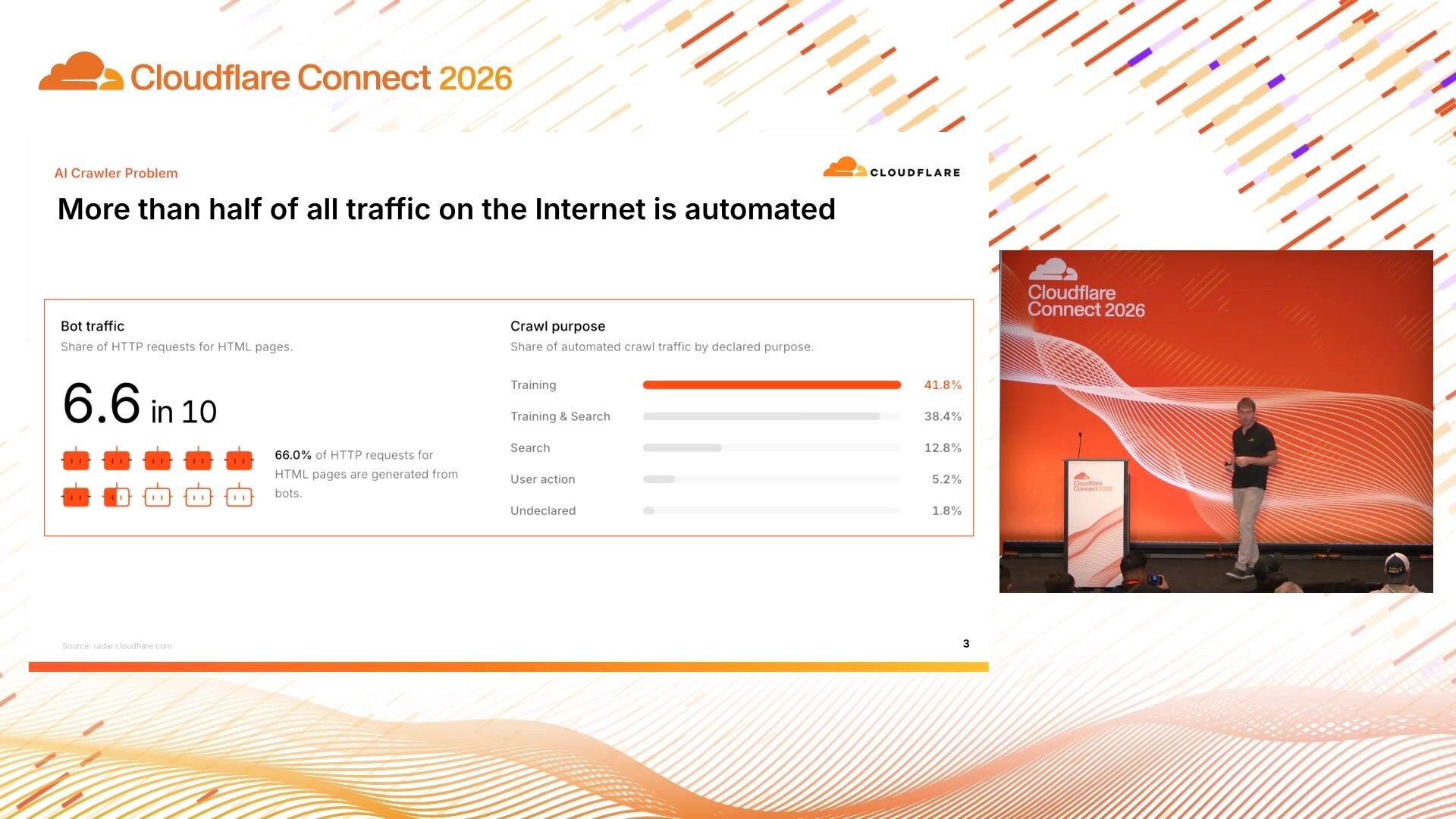
Michael Tremante
Cloudflare
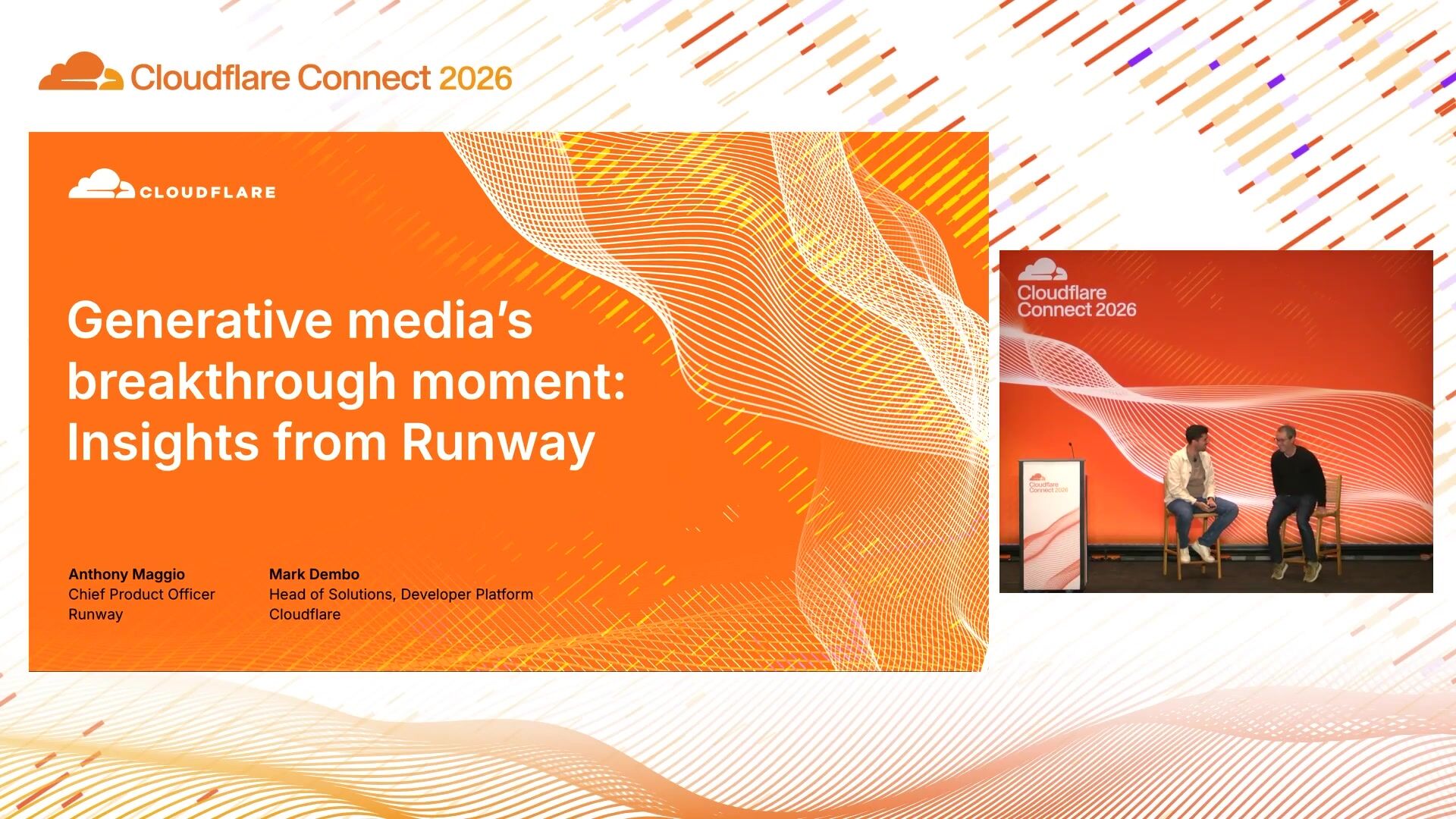
Anthony Maggio, Mark Dembo
Runway · Cloudflare
Be the first to know when registration opens and the agenda goes live.
---
title: "Screaming in the Cloud: Live interview with Cloudflare CTO Dane Knecht"
url: "https://www.cloudflare.com/connect/2026/session/screaming-in-the-cloud-live-interview-with-cloudflare-cto-dane-knecht"
year: 2026
---

# Screaming in the Cloud: Live interview with Cloudflare CTO Dane Knecht

[Watch session](https://www.cloudflare.com/connect/2026/session/screaming-in-the-cloud-live-interview-with-cloudflare-cto-dane-knecht)

## Session details

- **Track:** Agent Cloud
- **Topics:** Agentic identity, Agentic ROI, AI transformation
- **Solution areas:** Developer Platform

## About this session

In this episode of Screaming in the Cloud, host Corey Quinn will be joined by Dane Knecht, CTO of Cloudflare. They will engage in a wide-ranging discussion on the evolution of cloud computing, tracing how infrastructure is shifting from traditional cloud workloads toward an agentic cloud designed for autonomous AI agents. Along the way, Dane pulls back the curtain on Cloudflare’s own internal AI deployment. It’ll be a conversation about scale, resilience, and what happens to infrastructure philosophy when the Internet stops being mostly human.

## Speakers

- [Dane Knecht](https://www.cloudflare.com/connect/speakers/2519176) — CTO, Cloudflare
- [Corey Quinn](https://www.cloudflare.com/connect/speakers/2458556) — Chief Cloud Economist, Duckbill

## Transcript

[0:00] People want like very clear, sometimes rigid rules about like tell me I'm allowed to deploy X but not Y. And it's like well, if it was that simple then an agent could do it. The thing that I'm asking you to do is exercise human judgment and come back to me and tell me like okay, if we released this thing on a Friday afternoon, could I explain to a customer what happened if it caused an incident? >> [music]

[0:30] >> Ladies and gentlemen, please welcome to the Frequency Podcast stage Dane Connect and Rita Kozlov, joined by your host Corey Quinn. >> No, thank you both for agreeing to do this. I'm pleasantly surprised that it required less arm twisting than I would have thought. Uh a question I love to ask people at conferences every chance I get. It's perfectly calibrated for just how much of a jerk I want to be to someone based upon the scale of their company. You ask someone where they work and they give you an answer. And what no matter what that answer is, I like to respond with oh great, what do you folks do? So small scrappy startup, they're thrilled to tell you. Large giant bank, they get offended by this. And like the final form is some of the modern tech companies cuz they don't know either. So we're going to see where you all fall on that. Cloudflare, what do you folks do?

[1:16] >> We we help protect the internet at at at our core. Build a better internet and you know, we move packets faster than anyone else around the world and uh sprinkle some compute on that and uh some inference and uh uh let people build amazing things. >> Would you agree or are we going to start a fist fight here? >> That's my boss, so. >> Oh, I you kind of have to at that point. No, I get it. I get it. >> This episode is sponsored in part by my day job, Duck Bill. Do you have a horrifying AWS bill? That can mean a lot of things. Predicting what it's going to be, determining what it should be, negotiating your next long-term contract with AWS, or just figuring out why it increasingly resembles a phone number but nobody seems to quite know why is. To learn more, visit duckbillhq.com.

[2:04] Remember, you can't duck the duck bill bill, which my CEO reliably informs me is absolutely not our slogan. >> I had Matthew Prince on this show twice in previous years, and at the time it really did feel like Cloudflare was a CDN, but no one wants to talk about a CDN because that's only interesting to networking nerds, guilty. And then there was the other stuff you did sort of sprinkled on top. And and I'm not sure when that happened, but these days talking about you as a cloud provider, specifically I would argue the premier cloud provider that is legible to agents, stopped being something I guess aspirational and started being an accurate description of the reality. It it felt like it was a long time coming, but almost without noticing you got there.

[2:51] >> I think the fist would have come out even 10 years ago if you called this a CDN. That that was a term that we never really embraced. >> 10 years ago was actually when the developer platform started. And it really started as an internal platform for how how we could accelerate our own development. We like to ship a lot of things, as I'm sure most people know. And you know, in order to make it cost effective, you had to have a way of letting engineers iterate quickly and reduce reduce that that cost. You know, it started out just the one one compute serverless primitive. And actually at the time Matthew kind of told us he said you know, he said it takes 10 years for a platform. You know, maybe you get lucky and you do it in eight, but you know, no one really becomes a platform in less than 10 years.

[3:36] And maybe this changed with AI, but you know, it it took us the full 10 years I think to really kind of reach that level. >> It's strange in that the legacy cloud providers for lack of a better term, and I'm not I'm increasingly starting to think of them that way, everyone is saying that they are building for agents. That's the way of the future. That's the current state of the world. And you give an agent, a cloud code or whatever it is you're using, access to credentials in that environment and tell it to go and build a thing and it gives the polite corporate robotic version of what the hell is this and trips all over itself. Computers, they're just like us. Increasingly I have found that that is not the case in my weird ridiculous experiments on top of Cloudflare specifically. What if you found changes when the agent is now the primary consumer/implementer of your platform instead of a human being?

[4:30] >> I mean the legacy providers, they're still built on all the same primitives, right? And so then they just kind of change the label, the the stock agent in front of it. >> But there's still like an instance and then there's the block storage and the key the key defining characteristic is those teams are not allowed to talk to each other and it shows. >> At Cloudflare, you know, I I wish I could I wish I could say we 10 years ago predicted that agents would come and so we built all of it for for for this moment. But we did start out with fundamentally, first of all, a very different architecture, which it's really hard for the clouds to back into and that that's kind of Matthew and Michelle are students of Clay Christensen and that's kind of the whole innovator's dilemma, right? Is once you have this machine that's really working, that's been worked out around a single primitive, it's really really hard to roll out something that's going to disrupt it and be 100 times more efficient.

[5:21] The foundation that we were starting from when agents were becoming a thing 3 years ago and like as they've evolved was just very different and that's allowed us to I mean one thing that we do very much have in our DNA is innovation, having retaining an ability to have agility and flexibility when things come up. And so I I think it was a combination of we have the right foundation, but also once, you know, new protocols like MCP came out or we started paying attention to harnesses, like we're able to adapt very quickly to whatever is happening in that moment. >> I mean if you think about it, the whole cloud transition that everybody was been told to do for the last 20 years, it really was just shifting from a data center to another data center.

[6:08] You know, data center you owned to a data center owned by one of a couple people. >> Yeah, that's the lift portion of the lift and shift. The shift Yeah, we'll get to that later as soon as we finish migrating off the mainframe. >> I think S3 was a was a new kind of primitive uh but then it kind of regressed from there. Then it went back to just like oh yeah, we'll just give you a full machine and basically everything that you had uh in a data center before. Never kind of going back to uh you know core principles of like what are you trying to accomplish? You're trying to accomplish efficiency. You know, how can you make sure that every machine that you have is running you know as close to capacity at any given point? >> It it's weird in that things are speeding up incredibly, but also at the same time it feels like there's a there's a drag effect on it too. I remember a few weeks ago during your birthday celebration uh which is an interesting thing for a company to say.

[6:54] You released the CF command line tool which solved between Wrangler and your other one. I forget what it was. We were constantly at odds with each other. Hey, a unified experience. And I remember giving that to my agent the first day it came out like hey, use this instead. Cloudflare just released it and like watching its thinking traces were I don't know. Sounds like horse to me, but I'll give it a shot. And it also was trying to deploy things on top of Cloudflare Pages, which is largely been deprecated and not the way that you folks envision these things going on. But getting the new way of doing things into the into the weights and getting the old way the old ways of doing them out when there's 10 years of historical blog posts on it being baked in feels like it's an incredibly difficult challenge. >> There There were some arguments there. I I was like no, it needs to be called Wrangler cuz that's what the LOMs know.

[7:41] Uh it needs to be Wrangler 3. And And they're like no, no like you know we should have called it CF all along. That's better. And we're going to do it in a way that you know the agents will still just prefer it. It'll just be such a better experience for the agents. And I I think you know they've been proven right. Like you know first of all CF's a lot easier to type, but the agents seem to naturally be able to understand it. And it was kind of built actually more for an agent to use than a human to use. >> Oh the search >> operator, I've explained in plain English the thing you're trying to do and it spits it out. Awesome. I love it. I'm still trying to figure out how I can exploit that, you know, write Python code for me because why not? Everything's a database if you hold it wrong. The other side of it though, I have to say Wrangler was a bad name in that you go six months without touching it and what is this Wrangler thing installed on my system? CF at least you can trace down and sort of start to understand a bit more effectively.

[8:29] Legible to humans and legible to agents does seem to be converging. >> We hired an engineer who had just moved to Austin and they were like, yeehaw, Wrangler. Um and you know, you you find these things endearing and then like seven, eight, nine years later you're like, still called Wrangler. >> It's weird though the casual decisions we make like, yeah, I'll go back and fix that later and you realize inadvertently it's like, yeah, I'm just going to replace the entire foundation in that building and oh no, suddenly well I guess that's what we're calling it forever more. >> But it's interesting there's there's both sides to it. On one hand, there's everything that LLMs know and obviously it's hard to displace that. On the other hand, it's so much easier in some ways to get LLMs to adopt something new if you can be a bit intentional about it because you can just give it a prompt and it will follow that prompt to the T, whereas humans are really very bad at following instructions and we do fall back to old habits much more easily.

[9:24] So I think that that was something that the team put a lot of thought and effort into that helped make the transition to CF so much easier. Like the fact that you can give it a single prompt and um before even migrating between versions of Wrangler that was something that I very [snorts] painstakingly come to a customer and be like, you guys really should do this and they'd be like, I don't want to fiddle around with this for a month. I want to do other stuff that's actually important to my roadmap and now it's like just give it this prompt and they're like, yep, I'm done and we did this with a bunch of teams internally. >> It's a near certainty that there was an internal debate around this so I want to make sure I call out something that I like. Um every provider now has skills you can give your agent that winds up explaining how to interface with the various things that we're using, how to how to contextualize this platform that you've suddenly gotten exposure to.

[10:14] And a without naming names, a lot of them are basically SEO for agents of oh anytime someone wants to deploy it, make sure you use this. So I went through yours and it is remarkably even-handed across the board. It is if you are doing this on Cloudflare, then go ahead and do this other thing. It didn't turn into and remember Cloudflare is the best, which some other skill packs do. That has been wildly annoying to me when you especially god forbid you have two of those things installed. So as fun as it is to wind up yelling at companies when they get things wrong, I do like to take a point every now and then of making it obvious when you've done something right. I'm sure someone was like oh think of the growth hacking we could achieve if we just basically sell our customers for glue.

[11:01] >> Well I mean I think that's pretty baked in our DNA. You know things like even just from privacy to transparency to the customers are not our data and and you know so that is not like a top-down thing that you know that is kind of baked into you know the people that we hire. There there was no like conscious decision. I'm glad to hear that. I'm actually excited to hear that you you say this but I actually didn't even know that. >> I was expecting that some providers would absolutely let marketing run loose inside of those skills. >> And some do. >> Less than I was worried about originally though, which is kind of awesome. Like one thing I'm realizing now is that we've been begging as humans for the internet to be better in various ways for 20 years. And only now that agents are a thing are companies actually getting off their corporate asses and doing something about it where oh yeah it turns out that we if we stuff like 8 MB of JavaScript into 2 KB instruction file, agents are just not going to click on the ads or read it anyway.

[11:54] So we should just put the text on a text file and make that available. It's like the second greatest thing to happen to the internet. Like it's it's reminiscent of GDPR day when a bunch of companies were suddenly unprepared, didn't know how enforcement was going to work. And for a few days they turned off the JavaScript and the entire internet was blazingly fast. like, you could have had this, but telemetry is important. >> So, you know what's funny about that is on GDPR day was the first time I was Initially the original Workers PM and it was the first time that we saw a jump in Workers adoption because so many European customers just deployed a worker that said if EU just don't serve that website because US companies just didn't even want to deal with it and didn't didn't know how to. >> Yeah, I have thoughts on that. None of them are acceptable for public distribution at this point because I can't quite tamp down the blistering stream of profanity that winds up playing out.

[12:48] So, a few weeks before this conference was a bunch of your releases during your birthday week. Folks have had time to play with them and now basically talk to a number of the folks here about those enhancements. I think only a small subset of them started with you know what your problem is and then developed into violence from there. So, the question that has come up though, do you consider Connect to be a developer conference? >> I mean, I absolutely consider it to be a developer conference. We don't consider it a place to go announce things. We consider a place to a convenient experience where you get to go meet peers, you get to go meet fellow Cloudflare employees, you get to learn something. At least that's our that's our hope. Like that's why you know no one stood up on stage and said, guess what, you know these three big announcements that we're doing, that that was very intentional. >> So, I want to shift a little bit because something that you've talked about a number of sessions that I caught the abstracts of and poked my head in to listen to, how have you folks changed how you're building and deploying things via the use of AI?

[13:44] Because I can talk about the insane nonsense that I build primarily in service of posting, but there's a difference between he he if this goes really well, thousands of people will see it or a stuff that you do is now a statistically significant portion of the internet as a blast radius. I don't think you get to YOLO slam it into into creation quite the way that I do. >> But a little over a year and a half ago we kind of wrote down what our like our our AI principles were handling. You know number one and number two was no vibe coding. At least on on the engineering side. And that's you know, and we also said, you know, if something gets deployed to production, there's no blaming AI either. So, uh, we still very much, you know, humans write code, uh, humans plan, humans do that, you know, they might use AI to assist them, but they own uh, what they're building, what they're shipping.

[14:32] Uh, and and we use AI as a tool to help accelerate that. Uh, but not to replace human judgment, uh, human thought, human creativity. >> That's sad. AI is really good at things that humans are bad at, right? So, um, you can a human can review code and miss stuff that AI is going to catch. And so, AI has been really instrumental to our code review process and I think has actually helped prevent incidents that otherwise would have happened. And similarly, yeah, I I think kind of coming from a culture of ownership, like no-vib coding doesn't mean, uh, yeah, don't use AI. I think that one of the challenges that we're all kind of seeing now too is um, there are things that vib coding is really great at, like putting together a prototype or we have a lot of non-engineering teams that really embrace vib coding because it helps them build personal software that otherwise, you know, we we'd have to go get a SaaS license for something that serves like maybe like 10% of their need.

[15:36] Um, so so in some ways it's been very empowering, but I think being very clear about what's been reviewed by person and what's going into production, having human judgment also for, you know, which code does need to be thoroughly reviewed, um, because it's going to be deployed to the edge and it's part of like a very very core service versus like maybe this is something completely new and experimental and that's, you know, only a package that we're giving to people to try out, like those are those things are very very different. >> Or or or things that are just uh, annoying. A human not going to find excitement over uh, rewriting next to uh, be faster and safer to run and also build and run on Cloudflare. >> There >> are a few humans, but I hear you. >> Yeah, I mean there's there's one human originally uh Slopfork Steve.

[16:24] You know, he gave it the plan, he gave it the guidelines. I've been asking for that for years and they're like this this project that this this is horrible. Uh and and finally like the AI was like yeah well the AI didn't have a choice. >> Yeah. >> Well the the interesting thing about that is he tried that experiment twice, once in October of last year and he kind of kicked the tires with it and also got bored with it because the AI wasn't good enough. And then fast forward to um you know the models that came out in like November, December and all of a sudden they're cooking with fire. >> It's odd. There's a weird judgment aspect of it. People using these things love it. People who have to consume the thing that gets put out on the other end is awful. Like my AI factory, your Slop cannon and it becomes a different challenge. Something we've learned pretty clearly over the past year has been that five coding is awesome and five maintaining is terrible and five maintaining someone else's AI Slop is that they're building an annex onto the last circle of hell just for that.

[17:19] It's terrible. So on some level you almost start to rebuild things five or six times where a rewrite used to be a complete anti-pattern variety of ways and now it's starting to feel like for some things it's the best practice. >> I mean we always thought of workers of the platform where people build Greenfield applications cuz it's just a very opinionated architecture that you get a lot of great things when you do it, but you're not going to go port you know an application that's been running you know for 10 years move it over to us and we were kind of fine with that cuz still there's a lot more Greenfield stuff being built. But all of a sudden we're seeing people that have these prompts that are literally rewrite my application to run on Cloudflare workers and and migrate it for me. And and all of a sudden like that that process even becomes cheap. >> For me the wild part that of everything you've released this year, it is the ability to have an agent spin something up on Cloudflare without even having an account and then okay now you can go ahead and claim it if you decide you want to keep it.

[18:15] Just the abuse concerns on something like that, the scale concerns you have to be dealing with too make that it it's a it's miracle from my perspective it even got shipped let alone stuck around. It it's one of the that the fastest mean time to dopamine moments on deploying something for the world to see that I've ever heard of. >> Well well so two parts of that. One is the abuse part we have an amazing trust and safety team which we've you know had 15 years >> have to. >> Yeah which we've had 15 years to hone that skill. So you know there's still obviously a lot of abuse but we are we're pretty good at handling it. And then you know honestly just the cost to deploy something like that on our platform is really just minimal. And and that's just because how we designed it. And so you know you know that that that the abuse part is probably the bigger issue that's the bigger concern but the cost not really.

[19:07] >> The interesting thing is we've over the past year really invested in our dashboard experience which as someone that still uses it has gotten so much better but now we're seeing so many people on X being like oh I use Cloudflare without ever having touched a dashboard. I just told my agent to go X Y and Z they created the account for me and everything and that that's the new era that we live in and I think that that's a requirement now. >> Finally got started getting good at it and then no one cares anymore. >> You have to have a dashboard because a demo on stage of it here's working with Claude code like what's product are we demoing here doesn't work. But the thing that works well for customers who are using it is not necessarily the thing that looks great on a stage. Those are two very different use cases from a UX perspective as it turns out.

[19:53] And you have to have it. It is a baseline requirement but your common case increasingly is customers never seeing. >> I think an interesting take on it maybe is that it it allows us to focus on our efforts on things where you do kind of have to have it maybe to explain a unique concept or to really visualize something. And like for example CRUD dashboards should have never been complicated in the first place right? If you have a decent enough design system in place and that part has been accelerated for our internal teams too through having a design system where um we actually increasingly even have PMs that ship parts of the dashboard because we already have the predefined criteria. >> Well, that's the whole cloud company problem.

[20:38] The predefined design system. Huh, you only have one. We've got eight and there's where the problem starts. It's you can you can tell when you're leaving one team's remit and heading into another. Consistency is horrible. >> Well, we like to pave our own way. We went 15 years without one. And so we only have one. >> What I found interesting is some of this even exposes itself through CF where there is still some inconsistency between namespaces, how things work with various services and I still maintain fix it now because this problem only gets exponentially worse with time. But it's a it is one of those areas that's very hard to wind up getting deployed it because that requires centralized coordination in a company that benefits by launching things without that centralized coordination. >> This episode is sponsored by my own company, Duck Bill.

[21:25] Having trouble with your AWS bill? Perhaps it's time to renegotiate a contract with them. Maybe you're just wondering how to predict what's going on in the wide world of AWS. Well, that's where Duck Bill comes in to help. Remember, you can't duck the Duck Bill bill, which I am reliably informed by my business partner is absolutely not our motto. To learn more, visit duckbillhq.com. >> It's definitely a spectrum, right? If you want innovation to go fast then making it all go through a bottleneck is really really hard and so you kind of have to make the tradeoff of letting teams sometimes define their own and a big part of our culture is ship but fix quickly and don't let issues sit around and linger because the more they collect us, the harder they become to fix.

[22:17] >> AI has kind of helped improve that somewhat. We built this thing called our engineering codex which is uh a set of RFCs on how we built. Uh and it turns out agents are really good at following, you know, we should have had those rules already written down for humans, but we didn't really. Uh but >> It's on the backlog. We'll get to it next sprint for sure, right? >> It turns out agents are even better at following instructions when you write them down. Uh but then you know that we pair that with another kind of Cloudflare principle that we like uh like guidelines and not rules. Uh so you know you know cuz rules rules were made to be broken so you're allowed to ask for exceptions. But you know you you have a good reason it needs to be thought out. But uh at least we're all starting from a common place of uh here's how you build on Cloudflare successfully. >> Internally, how do you handle the approach of autonomy with AI? Because on on the one hand, just go ahead and do whatever your little heart desires.

[23:05] Oh no, the payments database is not great. And despite all the beautiful lies we tell ourselves about Agile, when it comes to payments, we all do waterfall for a very good reason. Uh on the other, you want to go full-on cautious, great. Now I'm just hitting approve on everything. I'm getting decision fatigue and I feel like a Claude condom, which isn't a great place to be in. Like that that feels like my job of hitting the enter button could be replaced by the Dicky Bird at some point. How do you find the right place on that continuum? How do you think about it? >> Well, I mean there are one-way doors and uh not I mean if you're deploying something uh to the core runtime of uh workers, that needs to go through a lot of reviews and uh but if you're deploying a worker on that, which uh is going to have a much smaller blast radius, then you can kind of uh uh manage the surface area, then you might have a different set of criteria.

[23:54] >> The problem I found is that it's very easy to identify a one-way door usually after you've gone through it. It I found interesting novel failure cases of AI doing we'll call it curious things. Uh no one is as zealous about backups for example as someone who's just lost data. Like it feels like it's one of those everything's easy to predict after it happens. Uh what was the process of getting there like? >> So we have a uh a pretty regimented incident process uh where uh >> Your write-ups are gold, absolutely gold. >> And that that's that's the kind of the final outcome of it. But but you know it starts from when we declare it uh uh how we document it throughout it, uh the follow-ups, the prevents that come out of that. Uh and that's also what led to writing the codex of actually documenting, okay, well, we know what works here and doesn't work here and here's how to build if you want something to work. That's been uh you know very successful for us and but you know I think it's a concept I mean we're we're learning and documenting and and hopefully you know it's it's okay to make a mistake once, lose some mistakes and uh you know we we don't punish anyone for that.

[24:50] Uh if you make a mistake twice >> It's hard to fire an agent too which makes it even harder. >> But but that's why we have humans, right? Because some of that is very nuanced and I think people are pretty uncomfortable with that. People want like very clear sometimes rigid rules about you know like tell me I'm allowed to deploy X but not Y and it's like well if it was that simple then an agent could do it. The thing that I'm asking you to do is exercise human judgment and come back to me and tell me like okay if we released this thing on a Friday afternoon could I explain to a customer what happened if it caused an incident or do you feel so confident that um actually you know what ship it on a Friday, why not, right? >> Or it's a brand new product and no one's using it.

[25:35] >> Yeah. >> Ship it ship it on a Friday. >> Yeah, there's almost like a tearing ring of at some point oh wow this this runs the core network. We should probably have some diligence around this rather than yeah it's probably fine. You'd hope but then you see some of the tier one ISPs you start to wonder how accurate that really is. So I'm curious at this point of it it feels like every time I turn around and think well okay this is what Cloudflare does. I draw a circle around it in my mind and reasonable people can disagree but for a long time the primary value was back when it was hard to get a domain name with an SSL cert in front of a website. Great it was the thing that I went to. Yes your website talked a lot about security but people only care about that after they just failed to. Fun day to say that with the entire internet melting down from a fundamental security layer but which that's neither here nor there. Then it became this idea of uh of being increasingly interesting things usually at the edge it was where you were the strongest and now it seems that with things like object store, things like D one, things like durable objects, things that are that are turning into an absolute reimagining of what a cloud provider is, where it starts, where it stops.

[26:44] It feels like it's very hard to figure out what you do in some ways. I think probably for me, the straw that broke my back was the idea of using you as an AI gateway where all inference can route through you. Now it feels like, okay, I start to need like a flowchart to figure out what aspects of this you are and what you aren't. Am I the only customer you have that's starting struggling to keep abreast of what it is that you're putting out or am I again, I could easily be the dumbest person in this room. It would not be the first time. >> No, I definitely say one of our Achilles heels is customers tend to not know everything we do. And you know, we we tend to you know, have you know, a customer that comes from this, you know, one area and they know the workers very well or they know our bot management very well.

[27:31] And that's probably how we were telling the story. You know, but I think you know, over the past year and hopefully at the our our keynote here at the the trade show, you know, people really got to see how we can explain the platform in a way that is a little more coherent and that kind of explains what we do and everything it possible to do on it that you can kind of imagine. >> Part of the challenge too is that what is possible on the platform today and what is possible three months from now are going to not be completely congruent. And one of the hardest problems in this era that we're in is building any plan for a release or a talk in advance. I gave a talk earlier this spring about how AI speak Terraform like a tourist and that thing aged like fine milk. It's it's one of those areas of yeah, it's really good at that now, which is helpful because Terraform clearly hates its user.

[28:22] That's kind of its feature. But we all put up with it. Now we don't have to. The other piece of it though is that I still maintain that the areas that are not going to be industrialized are wisdom judgment. And I'm hoping that that holds true at some point, but even if it if it doesn't, I'm not quite sure where that leaves us. Like, at some point like, oh yeah, your job is to sit here in case the agent screws up because we need somebody to sue. That's not a great seat to be in. >> First of all, I'm glad you're talking about how hard it is for people that present and speak that you can't reuse talks anymore. That that thing becomes out of date. Like I used to be able to reuse things like 6 months apart, a year apart, but that's no longer the case. >> No, that they they melt. They are absolutely unusable. You can reuse a few of the jokes, a few of the general themes, but well, get out, get out, get out.

[29:08] I've started even when I give talks now, I feel obligated to call out the date when I say it because otherwise it's going to turn into a huh, look at this bad take you had. Yeah, what, 2004? Imagine that. >> There's kind of two things to what you were saying before too, right? One that's what Cloudflare has been doing has evolved and continues to evolve and sometimes um yeah, the the release cycles are our customer We've always prided ourselves in innovation, which means that we release a lot and our customers have always struggled to keep up. Um but I I I think that yeah, and then there's the second part of it which is how do you communicate it um which I think we're getting better and better at. But I I think an interesting thing too is you know, you said another word that we would generally shy away from which is edge, which is where I think people kind of get confused about what we do, right?

[29:59] Because they associate Cloudflare very closely with like, oh I would want to use you for things that are very close to my users. And as you were saying, we're increasingly doing things like triple object through object storage. And I think what that plays more to is we never thought of ourselves as an edge for that reason of we think of ourselves as a smart network where we can route things to the place where it makes the most sense for it to run. It doesn't necessarily always have to mean like everything everywhere all the time. It can also mean in one place and at one point in time and another place and another point in time if that's what makes sense. >> Yeah, the the question of course is >> how you make that legible to people, where huh, I have a bunch of users in one part of the world and over time they find the experience gets better as the smart network, for lack of a better term, winds up relocating things closer to them.

[30:48] It does lead challenges with things like data residency, which is becoming an increasing problem as various governments realize that they can legislate themselves a data center investment if they say the right things. It is a brave new world out there in a lot of respects and it's certainly not getting simpler. I think the idea of being able to hold the entire stack in one person's head has long since ceased to be an accurate representation of reality, but I think we've held on to that fantasy for a while. It's getting harder and harder to credibly cling to that belief. >> I mean, I wonder if you fast forward how many people will even have the stack in their heads and how much of the stack is in their agents. >> A a question that I'm having right now and as a platform provider with a bunch of partners with booths and what not, many of whom fall squarely into this, what is the defining characteristic to your view of where someone should build their own implementation of a thing versus going and paying for a product that does that thing?

[31:46] Um an easy example here is great. I'm not going to be able to go out and build a global network for uh for reasonable use, especially given the current price of components for things, and I don't have eight years to spend playing that game. Clearly I'll go with a provider that's out there. But if I want to have a a service on a website that does a thing that's basically a a digitized version where its biggest competitor is Microsoft Excel, well suddenly now I'm debating do I build it or do I buy it? How do you see that on >> So at least for Cloudflare, we we kind of think of what are kind of the primary systems of record and where's like kind of that data gravity? And we want to reduce that, but we want to put put it in places that have you know that actually are pretty trustworthy software like you know for HR systems, we want to use something that understands compliance.

[32:31] You don't want to vibe code compliance. >> All the Frontier Labs are outsourcing payroll for very good reason. >> Things like payments >> or finance tooling, you know, I don't see anyone coding an ERP anytime soon. That's just also because the risk, right? Like, you know, the CFO doesn't want to go to jail cuz someone you know decided to use a bad model. And so so, you know, for us those are the types of things that we said, okay, those are going to stick around cuz that's kind of a risk. But we'll give people a playground kind of above that. We'll make sure that data is accessible, easy for them to use, put kind of governance around it to make sure it's not leaking. And let them build their own interfaces on top of it. But keep the workflow and the you know kind of lower level engine inside of those places, you know.

[33:17] >> How do you think about it? >> I mean I agree with Dane. I you know I think conventional wisdom has always been does it make your beer taste better, right? So if it doesn't actually help your customers, then you probably should buy it rather than build it. I I think that that's no longer entirely true because we do spend so much time using tools that meet like 30% of the thing that we needed them for. And the cost for building, yeah, especially an interface on top of a system of record is so so low that there's no reason not to just kind of build your own. >> It feels like the open source world figured this out a generation ago. Software could be free as a puppy where the maintenance becomes a nightmare because you build a thing that service that perfectly services your needs and as soon as you get a second user, all hell is other people's requirements.

[34:04] Now it seems like that is less of a barrier than it once was, but there is still value in folks that think very deeply about a problem today. >> Yeah, I mean I think it's okay for things to just be single user now too, right? Like I I think that that's where the maintenance burden becomes expensive is once you get that second, third, hundredth user, but there's there's certain software that's like this is for me. I want a view of my team so that I can you know do a particular activity maybe at a team on site and I no one else is going to use it and it took me 5 minutes to build. I didn't need to go out and um sign off all of Cloudflare's um you know data for me to have access to a tool. >> All right. I mean we're seeing you know every every person sales building their own dashboards and their own tooling on top of Salesforce, right?

[34:53] Which would just be unthinkable in the past. But so that comes personal software. They don't have to worry about it scaling out to the rest of the company. They just have to worry about doing what they needed to do that day and you know I'm pretty bullish on personal software uh which you know I think fits very well into Cloudflare because you can deploy it for one person and or deploy it for 100 people and it kind of scales the same way. Um and you know and and every once in a while one of those pieces of personal software might end up being something that uh you know it is a sleeper hit and it does need to scale up. >> I also believe we're increasingly in the idea of killing your pets where all right I've built some personal software that I've been iterating on and it's gotten it's drifted a lot for its use case. Great. Throw it away and start over. Uh here are the interface points maybe planning for data migration backups again your friend but build a second one in parallel. See if that winds up solving the need better.

[35:39] It almost becomes a schedulable tradition. >> Mhm. I think that's where Cloudflare is not only uniquely suitable for scaling up but also for just state staying scaled zero, right? It costs you nothing if you're getting no requests and you're not doing anything with it. >> Well I guess the last big topic I want to get into with you folks before we call it an evening here is for a long time folks were talking about dead internet theory the sort of a conspiracy theory that the internet was largely bots talking to each other and now that is very clearly a credible way of thinking about this as the as an increased percentage of traffic I believe might have been a majority now uh becomes uh automated rather than human driven or human directed that changes the internet foundationally.

[36:25] How do you think about that? Because again robots do many things more efficiently than human. One thing they don't do is click on the ads which is going to be a problem for an awful lot of business models. >> Yeah I mean uh you know right now humans and uh agents are kind of surfing on the same uh internet and uh it's kind of in messy period where uh the the needs to work itself out but they probably should not be on the same internet. They, you know, they probably are more efficient ways of the each of them interfacing with it and as well as more efficient ways of monetizing. Um, you know, I I think uh you know, when people have ads on a page they're they're they know what their CPM is. They know about how much they're going to make uh you know, cost per million on an ad. There's no reason why an agent can't just, you know, with a micro transaction just pay that. Um and and that's kind of like what we've been building with our monetization gateway.

[37:13] Uh you know, put sites behind us, let people decide what their CPM is and uh you know, give give an agent a wallet and you know, let them go go wild uh using it. Uh but we are trying to give you know, the the site owners and creators those type of controls whether uh let them decide who gets in and who doesn't. >> Of course defaults matter because that's going to be what most people will wind up taking but it's it's weird. Some folks absolutely do not want agents interacting at all with their site. And one of the more inscrutable ones to my mind is Amazon's retail where they will actively block anything that looks to be bot driven. It's like the bot is coming to your website to buy a thing and give you money in return for goods. Well, we're going to build our own because we're Amazon.

[37:59] It's going to have a terrible UX. It's going to ship three years late after everyone else wants it and you were just going to be surprised when it finds lukewarm success in the market if I can that a second. But it feels like it's emblematic of a larger trend where folks are clinging to the way things used to be almost in a denial of the fact that the sea is changing. >> I think yes and no. We've also seen customers shift their perspectives and I think a lot of people are evolving on their thinking about yeah, a few years ago the world was, you know, bot versus human and now it can increasingly be bot on behalf of human. And so you you want to allow that traffic and we had a whole, you know, part of our conversation that was about AO and agents buying things because there's information available.

[38:46] So we're also seeing businesses that are actually leaning in and trying to inversely give agents as much access as possible to their content because they they they want agents to recommend them and things like that. >> I mean we early on we saw a lot of sites that just did not want their traffic to be used for training. The personal agents coming, Dots, Muse, Grokbot, you know, it's actually changing. We're actually having people that say, hey how do I make sure I let this in? Uh cuz they actually do want that traffic. Um and you know so you know what we we're trying to work with all those providers are to make sure they sign the requests, that they clearly state what their intentions are. And then the site owner can decide you know I want this in I don't want this in. You know for the most part you know their incentives are aligned that you know they want they want them in.

[39:32] >> Yeah it's a hard problem to solve for. I don't I don't think there's any clear right answer no matter what you do especially at your scale. People are going to be mad mad about it. That that is what the internet does. It's very good at not accepting the two very complex complex things can both be true at the same time and that doesn't fit in their tweet so we're just going to get angry about it. It's not ideal. I think that we're going to be seeing some interesting changes. So okay Connect 2027. Let's assume it's a year from now. What's changed? >> Oh boy I even if you said Connect I don't know January 15th 2027. >> It used to be what's going to be different in 25 years and like oh by then we're definitely going to have quantum computing powered by cold fusion and now 25 years later you can say the exact same things but here we are. Some things are very clearly changing too so I don't know that I would want to put a prediction out there which is why I'm making it your problem instead.

[40:25] Dane what do you think? >> A higher majority of people will have personal agents that are you know are running for them both at work and at home. You know I think today you know we hear a lot about the GPU crunch. I think you'll hear more and more about the CPU crunch because harnesses and things like that need CPU. Um you know hopefully cloud first the default place where you deploy all your durable agents and everyone has you know hundreds of them making their life easier and lets them go spend time on higher value things. >> If I had to guess I think a lot of the breakthrough might very well come from folks one layer of the stack who are building on top of you folks where it becomes like that is the thing that becomes the household brand the recognized name in non-technical circles. I'm not sure that you'd want it to be the other way of yes we're now going into consumer products feels like it's a bit of a pivot there but being able to be the the underlying infrastructure primitives that everyone else starts to build upon increasingly I am seeing at least on the a lot of the transport layer that Cloudflare has well gotten into that point.

[41:30] >> Yeah I mean we were just just before this I was in a session where John from OpenAI was showing how GPT sites is built on Cloudflare. We had Fabian on stage with me yesterday who was showing how Lovable built on Cloudflare so in that sense we've always viewed ourselves as the infrastructure layer and our goal is to give people that are very good at building these consumer experiences and that's why I think there's a lot that's been left to imagination still there's so much that's been unexplored. One thing that I'm actually very bullish on is real time and voice feels very early on and what we're seeing more and more folks experiment with that so I think you're right that we're trying to play it kind of the the layer slightly below.

[42:20] >> I mean at our heart we're an infrastructure company and so you know while there was a lot of you know a lot of questions really on like why why don't you build build a you know vibe coding website builder we're like well because we want to build the platform and we want to build the primitives that let there be 10 of them on us or hundreds of them on us and I and I think largely that's kind of played out. >> I feel like there are two kinds of infrastructure company in the world the kind that are have not been that we're an infrastructure company great that empowers an awful lot of things please build on top us and infrastructure companies that are mad about it and like to dilute themselves thinking nope no we're going to move up the stack now and compete with all of the people that build on top of us. I almost wonder at some level if that's an inevitable consequence of getting to a certain point of scale but it's refreshing to hear that you folks are not inflict affected by that yet.

[43:09] That's the one thing I hope doesn't change. >> We have a lot of conversations about it internally every once in a while and you know what what that layer on top keep keeps changing and one thing that we will do sometimes mostly just so that we have experience in house in understanding our customers perspective is we will build like an internal instance and [snorts] sometimes we'll open source it as an example right to even show people what putting together the pieces would look like because also just being infrastructure that doesn't show you you know it's like how to draw a horse and step one is very simple and then no I I swear you you could get to a horse so so that's one direction that we've found ourselves leaning in but it's not to say that I think as a company you can definitely build new muscles and there are muscles that I'm very proud that we've built over time but also understanding where your strengths are and where you're better off you know either letting people build on top of you or partnering [snorts] allows you to focus your energy on the things like building infrastructure is really hard and we have no shortage of problems to solve over there.

[44:15] >> You you would think that would be more broadly accepted than it is but now we're into the realm of people promising data centers in three months and they think it's basically at some tents and a generator um good luck have fun with that. It it takes work legitimate hard work to get these things built in a way that's sustainable and scalable and it's nice to see that folks are sweating those details. >> That's our job. >> I want to thank you both for taking the time to speak with me if people want to learn more probably not the people here in this room you you probably should know where to go to figure out more what Cloudflare is up to but for folks listening where's the best way to get started with Cloudflare these days? >> Go to cloudflare.com or point your agent at it and ask what what you know what what what can I what can I do >> Cloudflare? How can I use it? How can I make my apps better? >> How can I make it hysterical and poster is usually my prompt, but it works.

[45:01] >> Yeah. >> Someone had a great suggestion the other day. We published a blog post about what we used for our own internal AI review tool, and they were like, I just started pointing my agent at Cloudflare blog posts and being like, extract the parts that I could reuse from this and like start implementing it. So, yeah. >> I still have this weird behavior every once in a while where an agent will look at this, point it to one of your blog posts, and it'll be skeptical and try to fact check the things that you say in the blog post, like I I made it up or something, like I'm trying to trick it. I'm sure someone out there has a good reason for it, but yeah. >> I promise we do a lot of fact checking before any of our blog posts go live. >> A lot of lawyers. >> Yeah. it turns out that they have opinions that you that you don't heed at your own peril. I've learned that over the years.

[45:47] Thank you both so much for taking the time out of your day to speak with me. >> Thanks again. >> Corey. >> Thank you. >> [music]

## Related sessions

- [No Priors: A live conversation with Dane Knecht, CTO of Cloudflare](https://www.cloudflare.com/connect/2026/session/no-priors-a-live-conversation-with-dane-knecht-cto-of-cloudflare)
- [Building an open agentic Internet: Discoverable, callable, and payable](https://www.cloudflare.com/connect/2026/session/building-an-open-agentic-internet-discoverable-callable-and-payable)
- [Generative media’s breakthrough moment: Insights from Runway](https://www.cloudflare.com/connect/2026/session/generative-medias-breakthrough-moment-insights-from-runway)

## More from Connect

- [All sessions](https://www.cloudflare.com/connect/)
- [Get notified for Connect 2027](https://www.cloudflare.com/connect#2027)


